

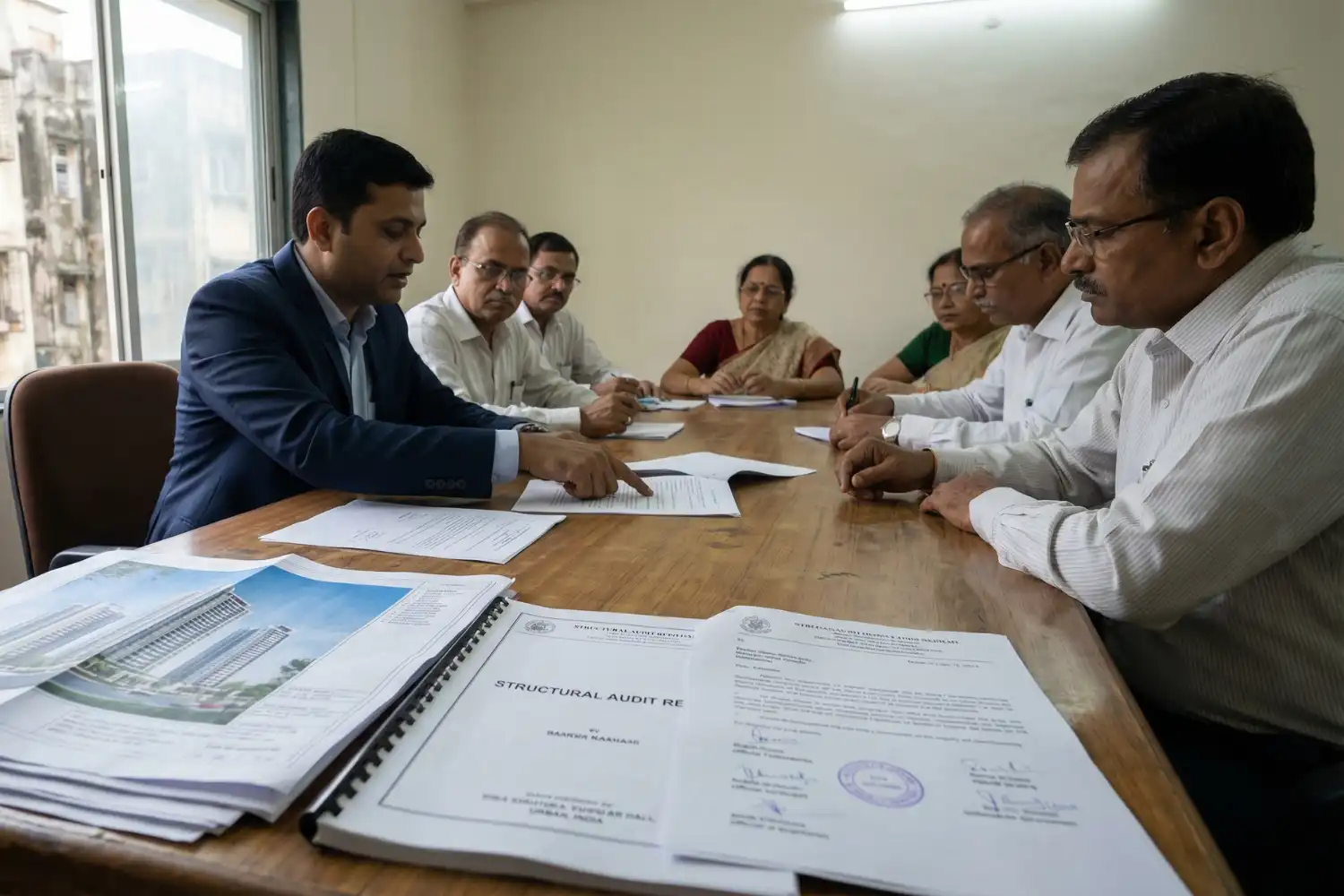
Redevelopment of an old building is a legally sensitive and financially significant process. Proper documentation ensures smooth execution, regulatory compliance, and protection of member rights. This guide provides a structured checklist of documents required for redevelopment in India.
In cities like Mumbai, Pune, Thane, Navi Mumbai, Delhi, Bangalore, and other urban centers, redevelopment has become essential due to aging infrastructure, increased FSI potential, and safety concerns. However, redevelopment is not just demolition and reconstruction; it is a complex legal transaction involving:
Property title verification
Society consent
Municipal approvals
RERA compliance
Developer agreements
Financial safeguards
Failure to verify proper building redevelopment documents in India can result in stalled projects, litigation, fraud, or financial loss to members.
This detailed redevelopment legal checklist (with special reference to Maharashtra practices) explains the essential documentation at every stage.
Title & Ownership Documents
Title verification is the foundation of any redevelopment project. Before appointing a developer, the land and building ownership must be legally confirmed and free from all encumbrances.
| Document | Purpose | Who Issues It |
|---|---|---|
| Conveyance Deed / Sale Deed | Proves society legally owns the land and building | Sub-Registrar office |
| Property Card / 7/12 Extract | Confirms ownership, survey number, land classification | Revenue / Talathi office |
| Non-Agricultural (NA) Order | Confirms land is converted from agricultural use | District Collector |
| 30-Year Title Search Report | Confirms clear, marketable, litigation-free title | Advocate (title search) |
| Previous Development Agreements | Reveals prior obligations or encumbrances | Prior developer / society |
| Encumbrance Certificate | Shows no mortgages or charges on the property | Sub-Registrar office |
→ Get your Property Title Search Report from Vivs.in conducted by qualified advocates with a written opinion on title clarity, encumbrances, and redevelopment readiness.
II. Society Documents (Cooperative Housing Societies)
In Maharashtra and most other states, redevelopment involves cooperative housing societies regulated under the Maharashtra Co-operative Societies Act, 1960. These society redevelopment documents are legally mandatory and must be in order before any developer is engaged.
| Document | Purpose |
|---|---|
| Society Registration Certificate | Confirms legal existence of the society |
| Society Bye-laws | Defines rights, quorum requirements, redevelopment procedures |
| Share Certificates of All Members | Confirms legal membership and flat ownership |
| Audited Financial Statements | Transparency on society funds and liabilities |
| Special General Body Meeting Resolution (75% consent) | Mandatory member approval under Maharashtra law |
| Appointment Letter of PMC | Project Management Consultant to supervise redevelopment |
Reference: Maharashtra Co-operative Societies — Official Portal (mcs.maharashtra.gov.in)
III. Municipal & Technical Approvals
Municipal permissions ensure that redevelopment complies with local building laws, FSI regulations, and urban planning norms. Construction without these approvals is illegal and can result in demolition orders and heavy penalties.
| Approval / Certificate | Issued By | When Required |
|---|---|---|
| Approved Building Plans | Municipal Corporation (BMC/PMC/NMMC etc.) | Before construction starts |
| Commencement Certificate (CC) | Municipal Corporation | Mandatory before any construction |
| Occupation Certificate (OC) | Municipal Corporation | After construction — for legal occupancy |
| Structural Audit Report | Empanelled structural engineer | Before redevelopment decision |
| Intimation of Disapproval (IOD) | Municipal Corporation | Lists compliance conditions pre-construction |
| Fire NOC | State Fire Department | Mandatory for most projects |
| Environmental Clearance | SEIAA / MoEFCC | For large-scale projects under EIA norms |
IV. Redevelopment Agreements
Redevelopment agreements are the contractual backbone of the entire project. They define rights and obligations between the society, individual members, and the developer. All critical agreements must be registered unregistered agreements have weak legal enforceability.
| Agreement | Purpose |
|---|---|
| Registered Development Agreement | Legally binds the developer to redevelopment terms, timelines, and FSI allocation |
| Permanent Alternate Accommodation Agreement (PAAA) | Guarantees each member their permanent flat after completion |
| Temporary Alternate Accommodation Agreement | Specifies rent/accommodation during construction period |
| Limited Power of Attorney | Allows developer to obtain approvals on behalf of the society |
| Bank Guarantee from Developer | Financial protection for members in case of developer default |
V. Financial & RERA Compliance Documents
Financial transparency and RERA compliance are non-negotiable in any redevelopment project of qualifying size. The Real Estate (Regulation and Development) Act, 2016 mandates registration, disclosure, and escrow requirements that protect society members from developer default.
| Document | Purpose |
|---|---|
| Developer PAN & GST Registration | Confirms lawful tax compliance of the developer |
| Developer’s Audited Financial Statements | Verifies financial capacity to complete the project |
| RERA Project Registration Certificate | Mandatory registration for eligible projects |
| Escrow Account Details (RERA) | 70% of project funds must be held in dedicated escrow account |
| Indemnity Bonds | Protects society from liability during construction |
| Insurance Policies (CAR Policy) | Contractor’s All Risk insurance for construction phase |
Step-by-Step Redevelopment Documentation Process
Commission a structural audit report from an empanelled engineer to establish the building’s condition and redevelopment need.
Engage a qualified advocate for a 30-year title search. Ensure conveyance deed is executed and there are no encumbrances. Vivs.in can conduct this search for your society.
Convene SGBM with proper notice and obtain minimum 75% member consent. Document minutes meticulously.
The PMC supervises the entire process, evaluates developer bids, and protects society interests throughout.
Issue a formal tender, evaluate technical and financial credentials, verify RERA registration, and check past project track record.
Register the Development Agreement, PAAA, and Limited Power of Attorney at the Sub-Registrar’s office.
For eligible projects, register with MahaRERA or the relevant state RERA authority. Obtain RERA registration number.
Developer obtains Commencement Certificate from the municipal authority. Construction may only begin after this stage.
Register a Permanent Alternate Accommodation Agreement with each member specifying their new flat details.
Members shift to alternate accommodation as per the Temporary Alternate Accommodation Agreement. Developer begins construction under PMC supervision.
Common Legal Mistakes in Redevelopment
- Incomplete title verification-the single most dangerous mistake
- Unregistered development or PAAA agreements- unenforceable in court
- No Bank Guarantee from developer-leaves members with no recourse if developer abandons the project
- Non-compliance with RERA-opens society and developer to penalties and complaints
- Improper documentation of 75% member consent-entire redevelopment can be invalidated
- Selecting financially weak developers without verifying audited financials and past track record
- Not clearly defining rent compensation terms in the Temporary Alternate Accommodation Agreement
- Ignoring indemnity clauses for construction-related damages and third-party liability
Need expert legal help for your society’s redevelopment?
From title verification and agreement drafting to RERA compliance and PMC coordination our team at Vivs.in has helped societies across Maharashtra complete redevelopment legally and safely.
Official Government Resources
These authentic government portals provide legal texts, RERA compliance tools, land records, and housing authority guidelines directly relevant to redevelopment in India.
Frequently Asked Questions
1. How many documents are required for redevelopment of a building in India?
Usually 25–35 key documents including title, society approvals, municipal permissions, and RERA compliance documents.
2. Is 75% consent mandatory for redevelopment in Maharashtra?
Yes, generally at least 75% member consent is required for redevelopment approval.
3. What is the most important document in redevelopment?
The registered development agreement and clear title documents are foundational.
4. Is RERA registration mandatory for redevelopment projects?
Most redevelopment projects above a specified size must be registered under RERA.
5. Why is a structural audit report required?
It establishes building conditions and justifies redevelopment.
6. What is a Permanent Alternate Accommodation Agreement (PAAA)?
It guarantees members permanent flats in the redeveloped building.
