MACT

Motor Accident Claim in India: Step-by-Step Legal Guide for Compensation

By April 8, 2026May 6th, 2026No Comments

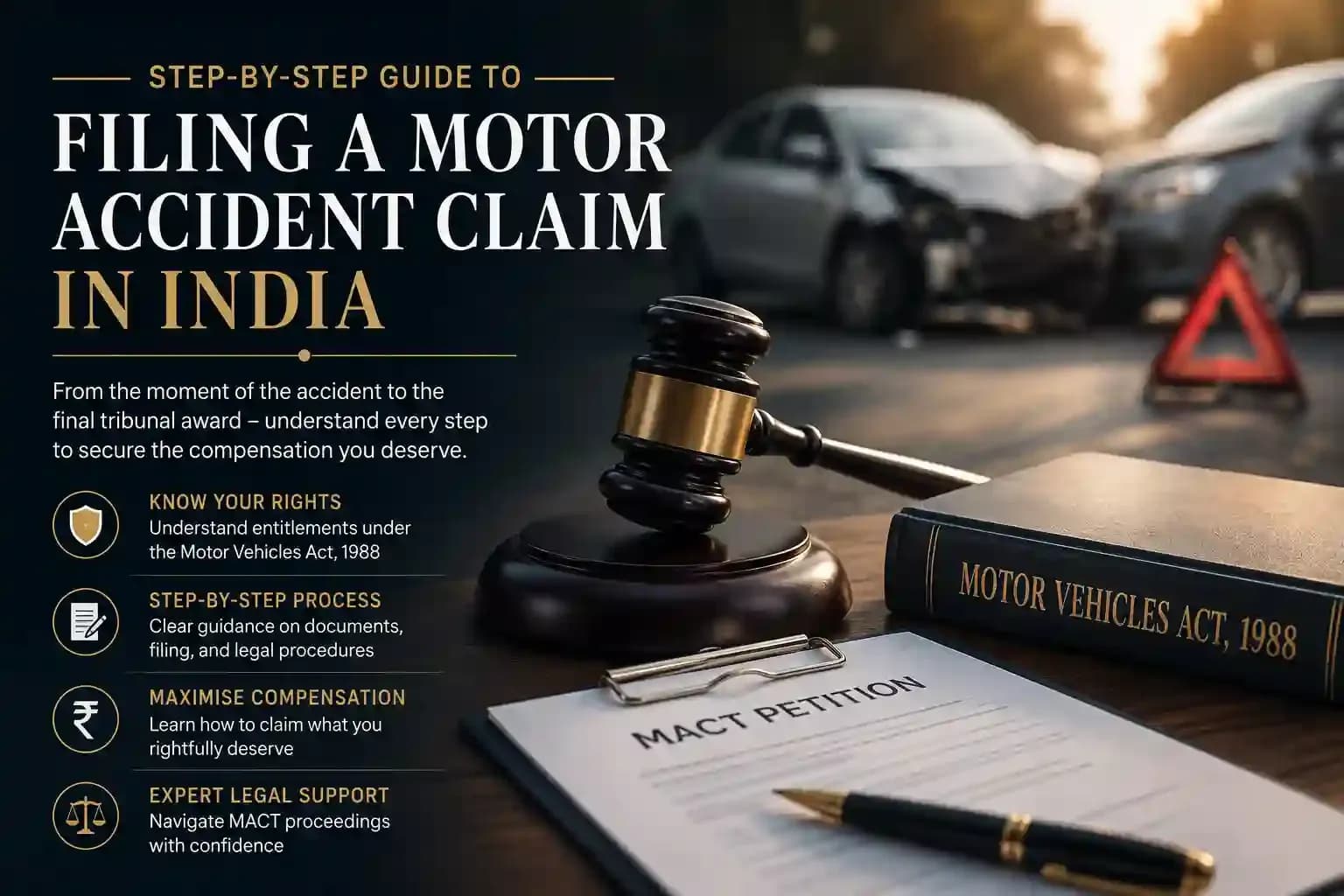
India registers over 4.5 lakh road accidents annually, according to data published by the Ministry of Road Transport and Highways. The legal framework for compensating accident victims under the Motor Vehicles Act 1988 is well-developed in its design. In practice, however, most accident victims and their families have no idea how to file a motor accident claim in India, what documents to gather, or what compensation they are entitled to claim. This step-by-step guide covers the full process from the moment of the accident to the final tribunal award.

Step 1: What to Do Immediately After the Accident

The actions taken in the immediate aftermath of a road accident determine the strength of every legal step that follows. Evidence degrades quickly, witnesses disappear, and the factual record of the accident becomes harder to establish with each passing day.

Filing the FIR: non-negotiable foundation

The First Information Report registered with the local police is the single most important document in any motor accident claim in India. It establishes the accident date, time, location, the vehicles involved, and the preliminary account of how the accident occurred. File the FIR at the nearest police station immediately and obtain a certified copy as soon as it is available. Any discrepancy between the FIR and your subsequent account of the accident will be exploited by the insurance company’s advocate. The FIR should accurately record all injuries sustained, even those that appear minor at the time of filing.

Gathering vehicle and insurance information

Record the registration number, make, and model of the offending vehicle along with the driver and owner details if obtainable. Photograph the vehicles, the accident scene, and any visible injuries. The insurance policy number of the offending vehicle can be obtained from the traffic police Motor Accident Report once the registration number is known. Without insurance details, the claim petition cannot be properly directed. Vivs Legal’s MACT claims lawyers assist clients in tracing insurance details where they could not be obtained at the accident scene.

Step 2: Medical Documentation and Treatment Records

Medical expenses form the most documentable component of any motor accident claim in India. Every aspect of treatment must be documented with original receipts, discharge summaries, and medical certificates. Losing or discarding medical records is one of the most common and costly mistakes claimants make in the months between the accident and the MACT petition filing.

Government hospital disability certificate

Where the accident has caused permanent disability, the disability certificate issued by a government hospital is the authoritative document for the MACT’s disability assessment. The certificate should accurately describe the nature of the disability and its functional impact on the claimant’s ability to perform their specific occupation. A disability percentage that does not address occupational impact understates the claim significantly for claimants whose livelihood depends on physical capacity.

Preserving income evidence

The income-based components of motor accident compensation depend entirely on documented income. Salary slips, Form 16, income tax returns, and bank statements are the standard forms of proof. Claimants who cannot document income are awarded compensation based on minimum wage benchmarks, which significantly understate actual earnings for most working adults. The Insurance Regulatory and Development Authority of India publishes guidelines on motor insurance claim handling that provide useful context for understanding insurer obligations in these proceedings.

Involved in a road accident anywhere in India? Speak with Vivs Legal’s MACT team free of charge to understand your compensation entitlement and the steps to claim it.

Step 3: Filing the MACT Petition

The Motor Accident Claims Tribunal petition is filed before the bench with jurisdiction over the accident location or the claimant’s place of residence. The petition names the owner and driver of the offending vehicle and their insurance company as respondents and specifies the compensation claimed under each applicable head.

Applying for interim compensation simultaneously

Filing the main petition without simultaneously applying for interim compensation under Section 140 of the Motor Vehicles Act is one of the most common and costly mistakes in MACT proceedings. Section 140 provides fixed no-fault compensation obtainable without proving negligence. These amounts provide immediate financial relief while the contested main claim proceeds. The Supreme Court of India has consistently upheld the right to interim compensation as an immediate and unconditional entitlement that should never be left unfiled.

How insurance advocates minimise awards

Insurance company advocates in MACT proceedings routinely challenge three aspects of claims: the claimant’s account of accident circumstances to establish contributory negligence, the disability certificate to reduce the disability percentage, and income documentation to argue a lower income base for multiplier calculations. Each challenge reduces the final award if not effectively countered. Vivs Legal’s MACT specialists prepare claimants for cross-examination on these specific points and present supporting evidence that anticipates and addresses these challenges proactively.

Frequently Asked Questions

1.How do I file a motor accident claim in India?

File an FIR immediately after the accident, then file a claim petition before the appropriate MACT. The petition must include accident facts, offending vehicle and insurance details, your injuries and losses, and demand compensation under all applicable heads. Apply simultaneously for interim compensation under Section 140 MVA for immediate financial relief.

2.What is the time limit for filing a motor accident claim in India?

There is no strict limitation period under the Motor Vehicles Act. However, file as soon as possible. Delay makes gathering evidence progressively more difficult and courts view unexplained delay negatively. File the petition as soon as medical treatment has stabilised sufficiently to document the injuries and losses properly.

3.Who pays compensation in a motor accident claim in India?

The insurance company of the offending vehicle under the mandatory third-party policy is the primary payer. If uninsured, the vehicle owner is personally liable. In hit-and-run or untraced vehicle cases, the Solatium Fund provides fixed compensation. The MACT issues the award jointly against owner and insurer, with the insurer typically paying directly.

4.How is compensation calculated in motor accident cases in India?

The Supreme Court’s structured formula multiplies the deceased’s net annual income by an age-based multiplier for fatal cases. Non-pecuniary heads are added at fixed amounts. For injury cases, medical expenses, income loss, disability compensation, and pain and suffering are calculated on the specific facts. Income documentation quality directly determines the income-based components.

5.Can I claim compensation if I was partly at fault?

Yes. Indian courts apply contributory negligence partial fault reduces but does not eliminate your entitlement. If found 30% responsible, the award is reduced by 30%. The burden of proving your contributory negligence rests on the respondent. An experienced MACT lawyer can contest disproportionate contributory negligence findings effectively.

6.What is interim compensation under the Motor Vehicles Act?

Sections 140 and 163A provide fixed compensation obtainable without proving negligence: Rs 50,000 for death and Rs 25,000 for permanent disablement under Section 140. Always apply for these simultaneously with the main petition filing to obtain immediate financial relief during the one to three year proceedings.

7.What documents should I collect immediately after a road accident?

Collect the FIR copy, registration and insurance details of the offending vehicle, photographs of the scene and vehicle damage, witness contact details, all medical bills and records from initial treatment, and the spot panchanama if prepared by traffic police. These documents are significantly harder to obtain as time passes.

8.What is the Solatium Fund under the Motor Vehicles Act?

The Solatium Fund provides compensation for victims of hit-and-run accidents and uninsured vehicle accidents where insurance companies cannot be made respondents. Fixed amounts are prescribed under the Motor Vehicles Act. Claims are filed before the MACT along with available evidence of the accident and any identification of the offending vehicle.

9.Can family members claim compensation if the accident victim dies?

Yes. Legal dependants including the spouse, children, and parents can file a MACT claim for loss of dependency, funeral expenses, loss of consortium, and loss of estate. The structured formula multiplies the deceased’s net annual income by an age-based multiplier. A legal heirship certificate identifying all dependants is required to file the claim.

10.How does the MACT calculate future loss of earning capacity?

Future loss of earning capacity is calculated by multiplying income by the disability percentage and applying an age-based multiplier reflecting remaining working years. The disability certificate from a government hospital determines the percentage. The income documentation submitted determines the base figure. Both are routinely challenged by insurance advocates, making accurate documentation and experienced representation critical.

From Accident to Award: Acting Systematically Pays Off

The motor accident compensation process in India rewards systematic action and thorough documentation. The claimants who receive the full compensation they are entitled to are those who file the FIR promptly, preserve every medical and income document, file the MACT petition with all compensation heads properly articulated, and apply for interim relief from the first day. The ones who receive significantly less are those who approach the process reactively, without legal support, and without understanding what the insurer’s advocate is trained to challenge.

Vivs Legal handles motor accident compensation claims across India with particular depth in Mumbai and Maharashtra tribunals. Book a free consultation to discuss your claim and understand exactly what you are entitled to recover.

Leave a Reply