- Chandigarh has no family court yet, so divorce petitions go to the District Courts in Sector 43 and appeals to the Punjab and Haryana High Court.
- Mohali and Panchkula are separate districts of Punjab and Haryana, so Chandigarh is open only if a Section 19 place is actually in the UT.
- A wife left behind can claim maintenance where she lives and have it executed against her husband's assets in India.
- A Canadian, UK or Australian divorce that the spouse in India never took part in may not end the marriage in Indian law.
- We advise and draft online from Navi Mumbai; how any Chandigarh hearing would be covered is settled at the first consultation.
On this page
- How our NRI divorce lawyer service for Chandigarh works online
- Which court hears a divorce in Chandigarh?
- Can you file in Chandigarh if both of you live abroad?
- Left behind by an NRI husband in Chandigarh or Punjab: what the law gives you
- Does a foreign divorce decree end a Chandigarh marriage?
- Filing in a Chandigarh court from Canada, the UK or Australia, step by step
- Documents to send for a Chandigarh-linked divorce
- Timelines and what decides the cost
- Mistakes that cost NRI clients time in Chandigarh cases
How our NRI divorce lawyer service for Chandigarh works online
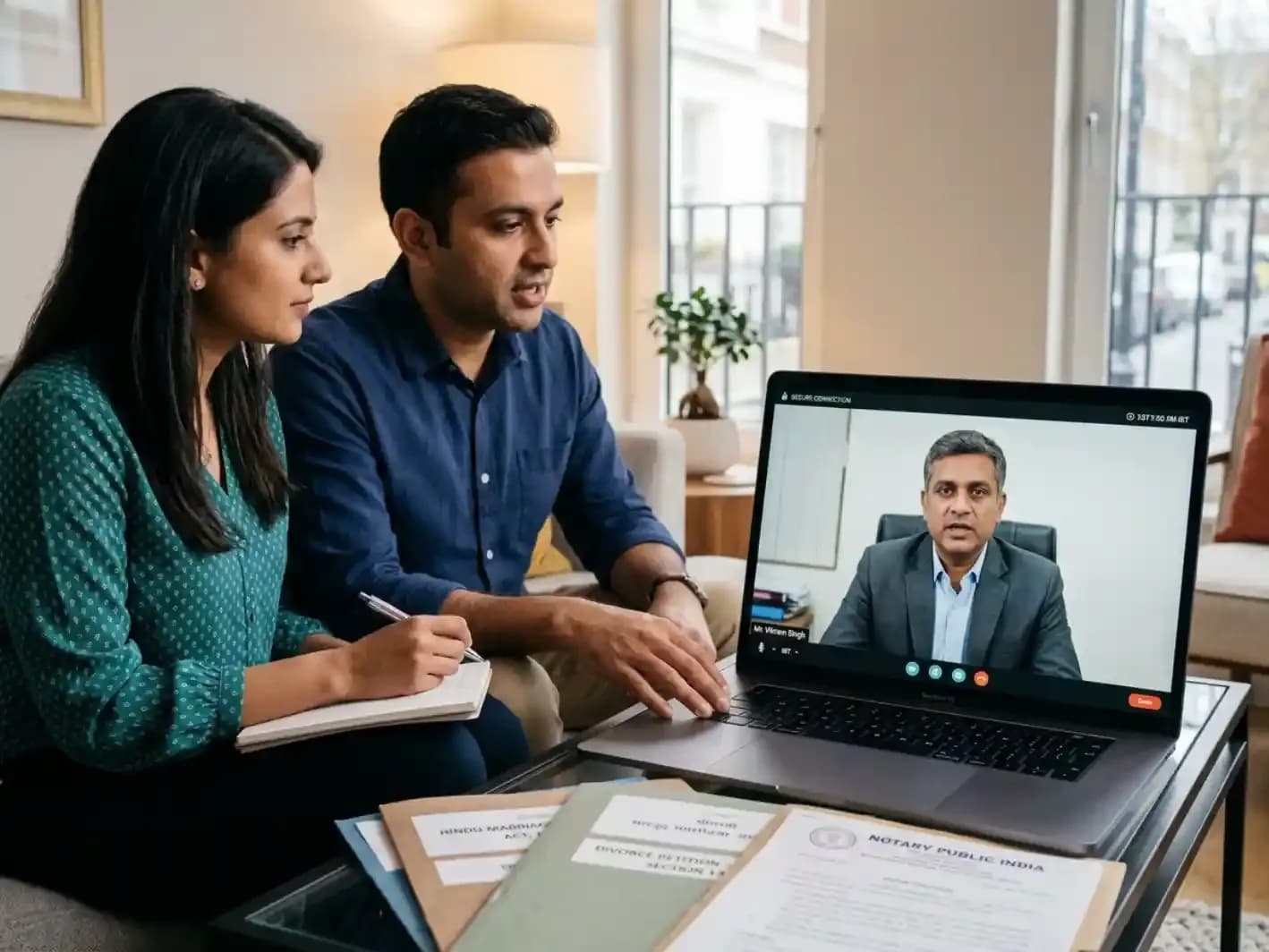
Most people who contact us about Chandigarh live in Canada, the UK, Australia or the US, or live in the tricity with a spouse abroad. The work that shapes the case can all be done remotely: reading the papers, choosing the court, drafting, and planning how notice will reach a spouse overseas.
- A first consultation by video, phone or WhatsApp, with documents shared by email
- A written note on which court can hear the case, which route fits, and a realistic timeline
- Drafts of the petition or reply, consent terms, maintenance applications and the Power of Attorney
- Advice on signing papers abroad and on appearing by video
- Working alongside your lawyer abroad where a foreign case is also running
Advice and drafting are led by Adv. Swanand Pandit, Advocate, High Court of Bombay, with Adv. Ashok Ingle handling filings and updates. A divorce filed in Chandigarh is heard there, so who attends each date, and at what cost, is agreed at the start rather than discovered later.
Which court hears a divorce in Chandigarh?
The District Courts in Sector 43. Chandigarh has no family court yet. One was approved years ago, and in August 2026 the Punjab and Haryana High Court, hearing a public interest petition, called its absence a serious issue. Until a family court starts work, petitions under the Hindu Marriage Act go to the district court, where matrimonial cases are assigned to a designated judge. Check the position when you file, because a family court will take these cases over once it functions.
| Matter | Where it is heard in Chandigarh |
|---|---|
| Divorce, judicial separation, restitution, nullity | District Court, Sector 43. |
| Maintenance under Section 144 BNSS (earlier Section 125 CrPC) | Judicial Magistrate, since there is no family court. |
| Domestic Violence Act applications | Judicial Magistrate. |
| Cruelty complaint under Sections 85 and 86 BNS (earlier Section 498A IPC) | Chandigarh Police, then the magistrate's court. |
| Appeal against a divorce decree | Punjab and Haryana High Court, Sector 1, within ninety days under Section 28 of the Hindu Marriage Act. |
| Quashing a criminal case, or moving a case to another court | Punjab and Haryana High Court. |
Chandigarh is one of three cities that run into each other. Mohali (SAS Nagar) is a district of Punjab and Panchkula a district of Haryana, each with its own courts. A couple who lived in Zirakpur or Kharar last lived together in Punjab, even if everyone at home calls it Chandigarh.
Can you file in Chandigarh if both of you live abroad?
Yes, if Chandigarh is one of the places Section 19 of the Hindu Marriage Act allows. For a couple both living abroad, that usually means the wedding took place in Chandigarh or your last shared home in India was in Chandigarh. Anand Karaj weddings are dissolved under the Hindu Marriage Act too, since it covers Sikhs.
- Married in Chandigarh, both now in Brampton. Either of you can file in Chandigarh as the place of marriage.
- Married in Ludhiana, last lived together in Sector 22 before leaving for Melbourne. Chandigarh as the last shared home, or Ludhiana as the place of marriage.
- Husband in Surrey, British Columbia, wife back with her parents in Chandigarh. She can file in Chandigarh, where she lives. He can file there too, because that is where she, the respondent, lives.
- Married in Panchkula, last lived together in Mohali, both now abroad. Chandigarh is not available. The case belongs in Panchkula or Mohali.
Starting in the wrong court costs months on a jurisdiction objection. And if no Indian place fits at all, the divorce has to happen abroad, which raises the question of recognition here. Our note on divorce laws for NRI couples sets out every Section 19 option.
Left behind by an NRI husband in Chandigarh or Punjab: what the law gives you
The pattern is familiar across the region. A wedding, a few weeks together, the husband back abroad, and a spousal visa that is never sponsored. The law offers several answers, and they can run side by side.
Maintenance from an NRI husband
Apply for maintenance under Section 144 of the Bharatiya Nagarik Suraksha Sanhita, 2023 (earlier Section 125 CrPC) where you live, and for interim maintenance under Section 24 of the Hindu Marriage Act once a divorce petition is pending. He has to disclose his foreign income on affidavit. An order is executed against what he holds in India: rent, bank accounts, a house, or a share in family land. If he owns property here, move quickly and ask the court to restrain a sale; an order made before a sale is worth far more than one made after.
Divorce in the first year
Section 14 of the Hindu Marriage Act bars a divorce petition within a year of the wedding unless the court gives leave for exceptional hardship. Desertion as a ground needs two years, and mutual consent needs a year apart. So a bride abandoned soon after the wedding often starts with maintenance and a Domestic Violence Act case, and files for divorce later or seeks leave under Section 14.
Criminal complaints and the passport
Where there was dowry harassment or cruelty, a complaint lies under Sections 85 and 86 of the Bharatiya Nyaya Sanhita, 2023 (earlier Section 498A IPC) and under the Dowry Prohibition Act, 1961. While a criminal case is pending against him in an Indian court, Section 10(3)(e) of the Passports Act, 1967 allows the passport authority to impound or revoke his passport, and a look-out circular can stop him leaving if he travels to India. These steps have serious consequences for both sides, so take advice before using them to press for a settlement.
Bodies that take NRI complaints in Punjab
Punjab has machinery of its own. The Punjab State Commission for Non-Resident Indians, set up under the Punjab State Commission for Non Resident Indians Act, 2011, deals with complaints from NRIs with a Punjab connection, including marriage disputes, and Punjab Police runs NRI police stations in several districts. Chandigarh is a Union Territory with its own police, so an offence committed in Chandigarh is reported to Chandigarh Police.
Does a foreign divorce decree end a Chandigarh marriage?
Not automatically. Many Chandigarh files begin with an email attaching a decree from Ontario, British Columbia, England or Victoria that the wife in India never answered. An Indian court tests that decree under Section 13 of the Code of Civil Procedure, as read in Y. Narasimha Rao v. Y. Venkata Lakshmi (1991). The ground and the foreign court's jurisdiction must both fit the Hindu Marriage Act, unless she took part in the case or consented to the divorce.
A year's separation, the usual basis in Canada, and no-fault breakdown, the basis in England and Wales and in Australia, are not Hindu Marriage Act grounds. So a decree she never contested is often open to challenge here. If you are the spouse in India, do not sign papers in the foreign case without advice. If you are the spouse abroad, do not remarry in India on the strength of that decree, because bigamy is an offence under Section 82 of the Bharatiya Nyaya Sanhita.
Since Chandigarh has no family court, a declaration that the marriage still subsists, or that a foreign decree does not bind, is sought by a civil suit under Section 34 of the Specific Relief Act, 1963. Clients in Canada will find more on Canadian decrees on our NRI divorce page for Canada.
Filing in a Chandigarh court from Canada, the UK or Australia, step by step
- Pin down the court. Confirm that Chandigarh, and not Mohali or Panchkula, is a valid Section 19 place for your marriage.
- Choose the route. Mutual consent if terms can be agreed; a contested petition on a Section 13 ground if not; maintenance or a declaration if divorce is not yet possible.
- Sign abroad. The petition, affidavits and a Power of Attorney for a relative in the tricity, signed before an Indian consular officer, or before a notary and then apostilled.
- Stamp and file. The Power of Attorney is stamped within three months of reaching India, and the petition is filed at the District Courts in Sector 43.
- Notice and statements. Notice reaches a spouse abroad by post, courier or email, or through the Hague Service Convention. Your own statement is recorded by video if the court permits.
- Decree and certified copy. Collect the certified copy, and send it to your lawyer abroad if a case is pending there too.
The practical detail of each stage, from the Power of Attorney to video appearances, is in our guide on how an NRI files for divorce in India.
Documents to send for a Chandigarh-linked divorce
- Marriage certificate, or the gurdwara or temple certificate with wedding photographs
- Passports, visas, PR cards or citizenship papers for both spouses
- Spousal sponsorship papers, visa refusals or other immigration correspondence, where the dispute is about a visa that never came
- Any foreign petition, order or decree, with proof of how it was served
- The husband's employer, salary and tax details abroad, as far as you know them
- Papers for property in India: Estate Office records for a Chandigarh house, or the jamabandi for land in Punjab
- A list of dowry articles and stridhan, and who holds each item now
- Copies of any police complaint, FIR or earlier court order
Scans are enough to start. Where a foreign order exists, send all of it, not a summary, because recognition often turns on how the case was served and who took part.
Timelines and what decides the cost
A mutual consent divorce usually takes seven to nine months from filing, or two to three if the court waives the six-month wait. A contested divorce usually takes two to four years before the first decree, and longer if maintenance, Domestic Violence Act and criminal cases run alongside. Notice through the Hague route can add several months.
The cost depends on the route, how many connected cases there are, how many dates need someone present in Chandigarh and how those appearances are handled, and whether a lawyer abroad is also involved. We give a written quote after reading your papers, not before.
Mistakes that cost NRI clients time in Chandigarh cases
- Filing in Chandigarh when every connection is in Mohali or Panchkula. The wedding, the last home and the respondent all decide the court, not the name people use for the area.
- Ignoring a foreign decree until a remarriage or a property sale depends on it.
- Withdrawing a complaint or maintenance case before the money arrives. The consent terms should fix the order in which each side performs.
- Leaving a maintenance order unexecuted while the husband's Indian assets are sold or transferred.
- Travelling to India with a criminal case pending and no anticipatory bail under Section 482 of the Bharatiya Nagarik Suraksha Sanhita.
For property disputes in the city that are not part of a divorce, see our note on property disputes in Chandigarh.

Founder and Managing Partner, VIVS Legal. BLS, LL.B, LL.M, PGDBM, JAIIB.