

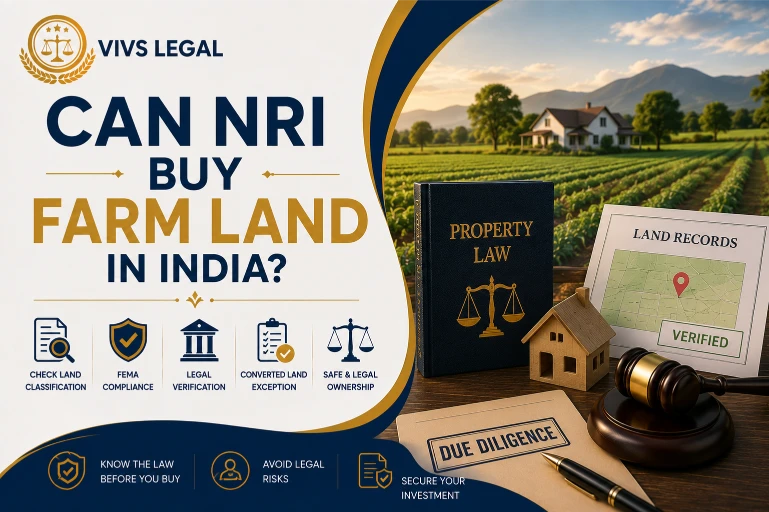
No, an NRI cannot buy farm land in India, and this includes properties marketed as farmhouses even when they are advertised alongside ordinary residential listings. The word farmhouse is doing a lot of misleading work in the property market, and understanding exactly what it covers under FEMA is the difference between a compliant purchase and one that puts your title at risk.
Why farmhouse listings cause so much confusion
Developers frequently market farmhouse plots as lifestyle or weekend-home properties, using residential-sounding language, amenities, and gated layouts. This framing suggests the purchase is treated like ordinary residential property. Under FEMA, it is not. If the underlying land is classified as agricultural, plantation, or farm land, the prohibition on direct NRI purchase applies regardless of how the listing is marketed or what structures sit on it.
What actually determines whether land counts as farm land
The determining factor is the land’s classification in official revenue records, not its marketing description or the presence of a residential structure. Land recorded as agricultural in the relevant state land records remains agricultural for FEMA purposes even if a house has been built on it, unless it has gone through a formal conversion process to non-agricultural use recognised by the state authorities. Checking this classification before any commitment is essential, not optional.
Converted land: the exception that requires proof, not assumption
Where agricultural land has been formally converted to non-agricultural use through the appropriate state process, and the resulting plot is genuinely classified as residential or commercial in the land records, the NRI purchase restriction no longer applies to that specific plot. This conversion status needs to be verified directly from the land records and the conversion order itself, not taken on a seller’s or developer’s word.
The broader FEMA framework this sits inside
Farm land and farmhouses fall under the same prohibited category as agricultural land and plantation property generally. For the full picture of what this prohibition covers, the inheritance and gift exceptions available, and what happens if it is violated, see our overview on agricultural land rules for NRIs.
Why developers sometimes structure sales to obscure the classification
Some developers structure farmhouse sales through arrangements that blur the line between purchasing the land itself and purchasing rights to use a structure built on it, sometimes involving lease arrangements or membership-style schemes rather than a straightforward sale deed. These structures deserve particular scrutiny, since they can be an attempt to work around the direct purchase prohibition through a technicality that does not actually change the underlying legal risk. If a deal is structured in an unusual way that a standard property purchase would not require, ask directly why, and be sceptical of an answer that amounts to working around the FEMA restriction.
What a genuine conversion order actually looks like
A genuine agricultural-to-non-agricultural conversion order is issued by the relevant state revenue or land authority, carries a specific reference number, and should be verifiable directly against that authority’s records, not just presented as a photocopy by the seller. Ask your advocate to independently verify the conversion order with the issuing authority rather than accepting it at face value from the transaction documents alone.
The difference between a farmhouse plot and a farmhouse structure already built
Whether the property is a vacant plot marketed for future farmhouse construction or an already-built structure changes the specific verification needed. For a vacant plot, land classification is the central question. For an already-built structure, you additionally need to confirm the construction itself was properly authorised on land that had genuinely undergone the required conversion, since an unauthorised structure built on unconverted agricultural land compounds the underlying legal risk.
Frequently asked questions
Is a farmhouse the same as agricultural land under FEMA?
Generally yes, if the underlying land is classified as agricultural in state revenue records. A residential-style structure being present does not change the FEMA classification. NRIs are prohibited from directly purchasing this category, regardless of how the property is marketed or what amenities surround it.
How do I check if land is classified as agricultural?
Check the official land records maintained by the relevant state revenue department, which record the land’s classification directly. A local advocate can pull and verify these records before you commit to a purchase, which is far safer than relying on how the seller or developer describes the property.
Can converted agricultural land be purchased by an NRI?
Yes, if the land has gone through a formal state conversion process to non-agricultural use and is genuinely reclassified as residential or commercial in the records. This conversion status must be verified directly from the land records and the conversion order, not assumed from marketing materials.
What if I have already bought a farmhouse without checking the classification?
This should be reviewed with a lawyer immediately, since an unauthorised purchase is a FEMA contravention that can carry penalties and put your title at risk. Depending on the facts, regularisation through an RBI compounding application may be available, but this needs case specific legal advice.
Do gated farmhouse communities avoid the agricultural land restriction?
Not automatically. A gated layout or residential branding does not change the underlying land classification. What matters is whether the land is officially recorded as converted to non-agricultural use. Many farmhouse developments sit on land that has never been through this formal conversion process.
Why do some farmhouse sales use unusual structures like leases or memberships?
These structures sometimes attempt to work around the direct purchase prohibition through a technicality that does not actually change the underlying legal risk. If a deal is structured unusually compared to a standard property purchase, ask directly why, and be sceptical of any answer amounting to a workaround for the FEMA restriction.
How do I know if a conversion order is genuine?
A genuine conversion order carries a specific reference number issued by the relevant state authority and should be independently verifiable directly against that authority’s records. Ask your advocate to confirm this directly with the issuing authority rather than accepting a photocopy from the seller at face value.
Does it matter if the farmhouse structure is already built versus a vacant plot?
Yes. For a vacant plot, land classification is the central question. For an already-built structure, you additionally need to confirm construction was properly authorised on genuinely converted land, since an unauthorised structure on unconverted agricultural land compounds the underlying legal risk considerably.
This does not resolve the underlying land classification issue, which is the actual FEMA concern rather than the structure itself. If the land remains classified as agricultural and unconverted, the prohibition on direct NRI purchase still applies regardless of whether any structure exists on it.
Verify the Land Records Before You Believe the Listing
A farmhouse listing that looks like an ordinary residential purchase can turn out to be exactly the category of land NRIs are prohibited from buying. The listing description tells you nothing reliable. The land records do.
Considering a Farmhouse Purchase in India?
VIVS Legal checks land classification and conversion records before NRI clients commit to a farmhouse or farm land property.
Get a Free Legal ConsultationVIVS Legal verifies land classification and conversion status before NRI clients commit to a farmhouse or farm land purchase. Read more in our NRI legal services.
Written by Adv. Swanand Pandit, BLS, LL.B, LL.M, Advocate, High Court of Bombay, Director, VIVS Legal. Last updated 15 August 2026.
