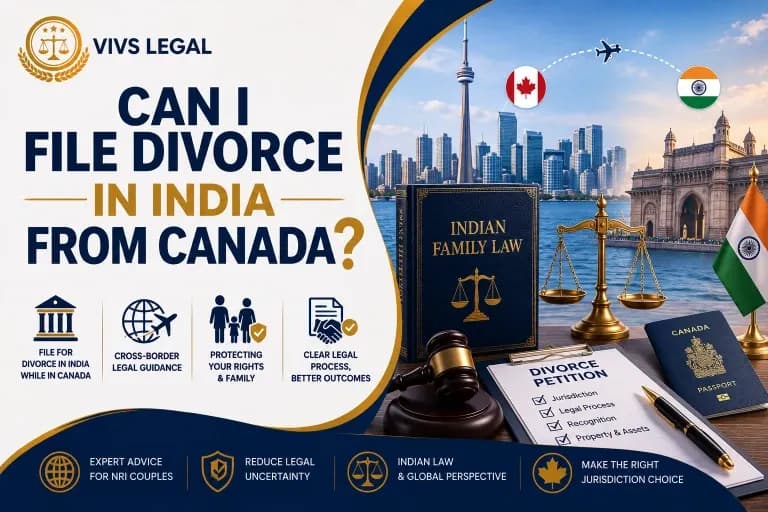
Yes, if you are an NRI living in Canada, you can generally file for divorce in an Indian court, provided the Indian court has jurisdiction under the applicable marriage law. This is a genuine choice many couples in Canada have, and choosing between an Indian court and a Canadian court is a decision worth making deliberately, not by default.
Why you might have a choice between India and Canada
If the marriage was solemnised in India, or if the parties last resided together in India before moving to Canada, an Indian court may have jurisdiction under the Hindu Marriage Act, 1955, alongside whatever jurisdiction Canadian family courts may also have based on residence in Canada. Having two possible jurisdictions is not automatically a problem, but it means the choice of where to file should be made deliberately, weighing cost, timeline, and how each country’s decree will be treated by the other.
The risk of parallel proceedings
If one spouse files in India and the other separately files in Canada, both proceedings can run at the same time, creating conflicting timelines, costs, and potentially conflicting outcomes. This is a genuinely complicated situation that needs coordinated legal advice across both jurisdictions, ideally before either proceeding is filed, rather than after two separate cases are already underway.
Recognition of an Indian decree in Canada
Whether a divorce granted by an Indian court is recognised in Canada depends on the specific facts and Canadian private international law principles governing foreign divorce recognition. This should be confirmed with a Canadian family lawyer alongside your Indian advocate, particularly if remarriage or other legal steps in Canada are planned afterward.
Why choosing India can still make sense
For many NRI couples with strong ties to India, family, assets, or where the marriage itself was solemnised, filing in India can be more straightforward and, in some cases, more cost effective than a Canadian proceeding, particularly for a mutual consent matter. For the actual filing steps once you have decided India is the right forum, see our guide on how to file divorce in India from Canada.
How Canadian courts approach jurisdiction in these cases
Canadian family courts generally assert jurisdiction based on habitual residence, meaning where the parties have actually been living, rather than where the marriage was solemnised. This is a genuinely different test from the Indian approach, which can look to the place of solemnisation as one of several connecting factors. Understanding both tests, not just the Indian one, is necessary to properly evaluate whether you have a real choice of forum or whether one country’s courts are clearly the only realistic option.
Cost comparison between the two jurisdictions
Canadian family law proceedings, particularly contested ones, can carry significantly higher legal costs than an equivalent Indian proceeding, reflecting differences in hourly billing practices and the general cost of litigation between the two countries. This is not a reason to automatically choose India, since other factors, including where assets are located and how enforceable the eventual order needs to be, matter just as much as headline cost, but it is a genuine input worth weighing honestly.
What happens to property and assets held in Canada
Property and assets held in Canada generally fall within the jurisdiction of Canadian courts for division purposes, regardless of where the divorce itself is granted, since an Indian court has limited practical ability to make binding orders over Canadian-situated assets. Where significant Canadian assets are involved, coordinating the property settlement with Canadian counsel, even if the divorce itself proceeds in India, is often the practical approach.
Frequently asked questions
Can I file for divorce in India if I live in Canada?
Yes, provided an Indian court has jurisdiction, typically based on where the marriage was solemnised or where the parties last resided together. This is often a genuine choice alongside filing in Canada, and the decision should weigh cost, timeline, and how each country’s decree is later treated by the other.
What happens if both spouses file in different countries?
Parallel proceedings in India and Canada can run simultaneously, creating conflicting timelines, costs, and potentially conflicting outcomes. This situation needs coordinated legal advice across both jurisdictions as early as possible, ideally before a second proceeding is filed in response to the first.
Will Canada recognise a divorce granted by an Indian court?
This depends on Canadian private international law principles and the specific facts of your case. Confirm this with a Canadian family lawyer alongside your Indian advocate, particularly before relying on the Indian decree for remarriage or other legal purposes within Canada.
Is filing in India cheaper than filing in Canada?
This varies by case, but a mutual consent matter filed in India can often be more cost effective than a comparable Canadian proceeding, particularly where both parties are cooperative. This should be compared directly against your specific circumstances rather than assumed as a general rule.
How does a Canadian court decide if it has jurisdiction over my divorce?
Canadian family courts generally look to habitual residence, meaning where the parties have actually been living, rather than where the marriage took place. This is a different test from the Indian approach, so understanding both is necessary to properly evaluate whether you genuinely have a choice of forum.
Is it cheaper to get divorced in India than in Canada?
Often yes, particularly for contested matters, given differences in billing practices and general litigation costs between the two countries. This should not be the only factor in your decision, since asset location and enforceability needs matter just as much, but it is a genuine and honest input worth weighing.
Can an Indian court divide property that is located in Canada?
Generally not effectively. Canadian-situated assets fall within the practical jurisdiction of Canadian courts for division purposes, regardless of where the divorce is granted. Where significant Canadian assets exist, coordinating the settlement with Canadian counsel is usually the practical approach even if the divorce itself proceeds in India.
Should I get a preliminary opinion from a Canadian lawyer before choosing where to file?
This is generally advisable, particularly where genuine jurisdiction exists in both countries or significant Canadian assets are involved. A brief consultation with Canadian counsel alongside your Indian advocate helps you make an informed choice rather than deciding based on Indian considerations alone.
Make the Jurisdiction Choice Deliberately
Having a choice between two countries is an advantage only if the choice is made with full information. Get advice on both sides before deciding where to file, not after a proceeding is already underway in one country.
Weighing Whether to File in India or Canada?
VIVS Legal advises NRI clients in Canada on jurisdiction and filing strategy for divorce proceedings in India.
Get a Free Legal ConsultationVIVS Legal advises NRI clients in Canada on jurisdiction and filing strategy for divorce proceedings in India. Read more in our NRI divorce lawyer services.
Written by Adv. Swanand Pandit, BLS, LL.B, LL.M, Advocate, High Court of Bombay, Director, VIVS Legal. Last updated 15 August 2026.