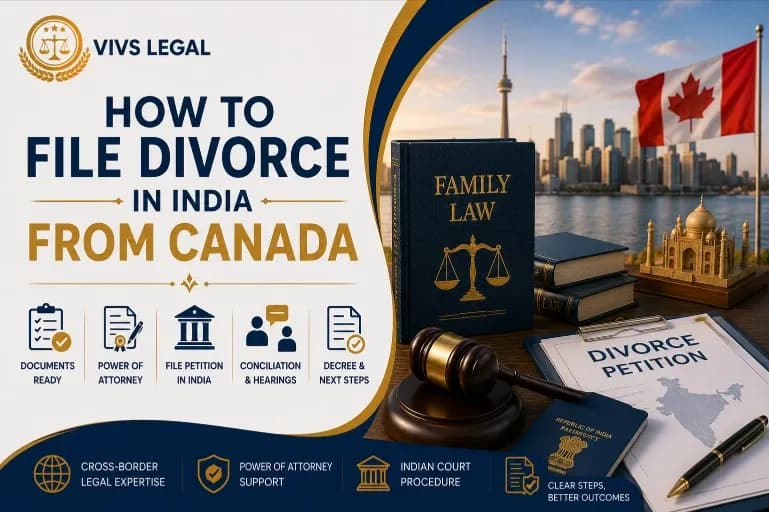
Once you have confirmed that an Indian court has jurisdiction and that filing in India is the right choice, the actual process of filing from Canada follows a defined sequence. This guide walks through the practical steps, from documentation to the first hearing.
Step 1: gather the documentation
This includes the marriage certificate, proof of identity and address for both spouses, evidence of the period of separation where relevant, and any documentation supporting the ground pleaded if the matter is contested. For a mutual consent filing, a draft settlement covering alimony, custody, and property should also be worked out in advance with your advocate.
Step 2: execute a Power of Attorney if you cannot travel for every step
A Power of Attorney executed in Canada needs to be attested at the Indian consulate or embassy serving your region, then adjudicated and stamped once it reaches India. This allows your advocate to handle filing and many procedural steps on your behalf, though appearance at the mutual consent motions typically still requires the petitioner’s presence.
Step 3: filing the petition
The petition is filed before the Family Court with jurisdiction, along with the supporting documents and, for mutual consent matters, the settlement terms. Your advocate can manage this step directly using the attested Power of Attorney, without requiring you to be in India at the time of filing itself.
Step 4: the conciliation stage and hearings
Section 9 of the Family Courts Act, 1984 requires the court to first attempt a settlement between the parties. Plan your travel around the hearing dates likely to require your personal presence, particularly the first and second motion in a mutual consent matter, and confirm with your advocate well in advance which hearings genuinely need you there versus which can proceed with representation alone.
Step 5: the decree and what comes after
Once the decree is granted, obtain certified copies for your records and for any use in Canada, and confirm whether Canadian recognition of the decree requires any additional formal step for your specific purposes. For the broader jurisdictional question of whether India or Canada is the right forum, see our guide on filing for divorce in India from Canada.
Getting documents apostilled or attested for use in India
Canadian documents intended for use in an Indian court proceeding, such as a marriage certificate issued in Canada or an affidavit sworn there, typically need to be authenticated for use in India, a process that may involve notarisation in Canada followed by attestation at the Indian consulate or High Commission. Confirm the exact authentication chain required for your specific documents with your advocate early, since this process can take weeks and holds up the overall filing if left until the last minute.
Budgeting for the full cost of a Canada-connected filing
Beyond the advocate’s professional fee, budget for Power of Attorney attestation costs at the Indian consulate, document translation if any documents are not in English or Hindi, courier costs for physical document exchange, and travel costs for any hearings that require your personal presence. These additional costs are routinely underestimated when planning is based only on the headline legal fee quoted at the outset.
Staying informed between hearings while in Canada
Given the time difference and distance, establish a clear communication cadence with your advocate from the outset, whether scheduled calls after each hearing or a written update within a specific timeframe. Waiting passively for updates, particularly across a proceeding that can run for many months, tends to leave NRI clients feeling out of the loop at exactly the points where clarity matters most.
Frequently asked questions
What documents do I need to file for divorce in India from Canada?
The marriage certificate, identity and address proof for both spouses, evidence of the separation period, and for contested matters, documentation supporting the ground pleaded. For mutual consent, a draft settlement covering alimony, custody, and property should be prepared in advance with your advocate.
Do I need to travel to India to file the petition?
Not to file the petition itself, if a properly attested Power of Attorney is in place, allowing your advocate to file on your behalf. However, mutual consent motions typically still require the petitioner’s personal appearance, so travel is usually needed at that stage even if not for filing.
How is a Power of Attorney for divorce filing executed from Canada?
It needs to be attested at the Indian consulate or embassy serving your region in Canada, and then adjudicated and stamped once it reaches India. Getting this attestation step right avoids delays or rejection when the document is presented to the court or registration authorities.
Which hearings require my personal presence if I file from Canada?
The first and second motion in a mutual consent matter typically require personal appearance, since the court must confirm consent is free and genuine. Your advocate can confirm which specific hearings in your matter need your presence versus which can proceed with representation alone.
Do my Canadian documents need special authentication to be used in an Indian court?
Yes, typically involving notarisation in Canada followed by attestation at the Indian consulate or High Commission. Confirm the exact authentication chain required for your specific documents with your advocate early, since this process can take weeks and delays the overall filing if left until the last minute.
What costs beyond the legal fee should I budget for filing from Canada?
Budget for Power of Attorney attestation costs, document translation where needed, courier costs for physical document exchange, and travel costs for any required hearings. These additional costs are routinely underestimated when planning is based only on the headline legal fee quoted at the outset.
How should I stay updated on my case while living in Canada?
Establish a clear communication cadence with your advocate from the outset, whether scheduled calls after each hearing or a written update within a specific timeframe. Waiting passively for updates across a proceeding that can run for many months tends to leave clients feeling out of the loop when clarity matters most.
Can documents be translated if they are not in English?
Yes, and this should be arranged through a certified translator recognised for legal purposes, not a casual or informal translation. Confirm with your advocate which specific documents in your case require translation and the certification standard the court expects before submitting anything.
Plan the Sequence Before You Book a Flight
Filing from Canada is entirely workable, but it goes more smoothly when the documentation, Power of Attorney, and travel planning are coordinated in advance with your advocate, rather than figured out hearing by hearing as the matter proceeds.
Ready to File for Divorce in India From Canada?
VIVS Legal manages the full filing process for NRI clients in Canada, including Power of Attorney documentation and hearing coordination.
Get a Free Legal ConsultationVIVS Legal manages the full filing process for NRI clients in Canada, including Power of Attorney documentation and hearing coordination. Read more in our NRI divorce lawyer services.
Written by Adv. Swanand Pandit, BLS, LL.B, LL.M, Advocate, High Court of Bombay, Director, VIVS Legal. Last updated 15 August 2026.