
NRI divorce lawyer in Mumbai: running your Bandra Family Court case from abroad
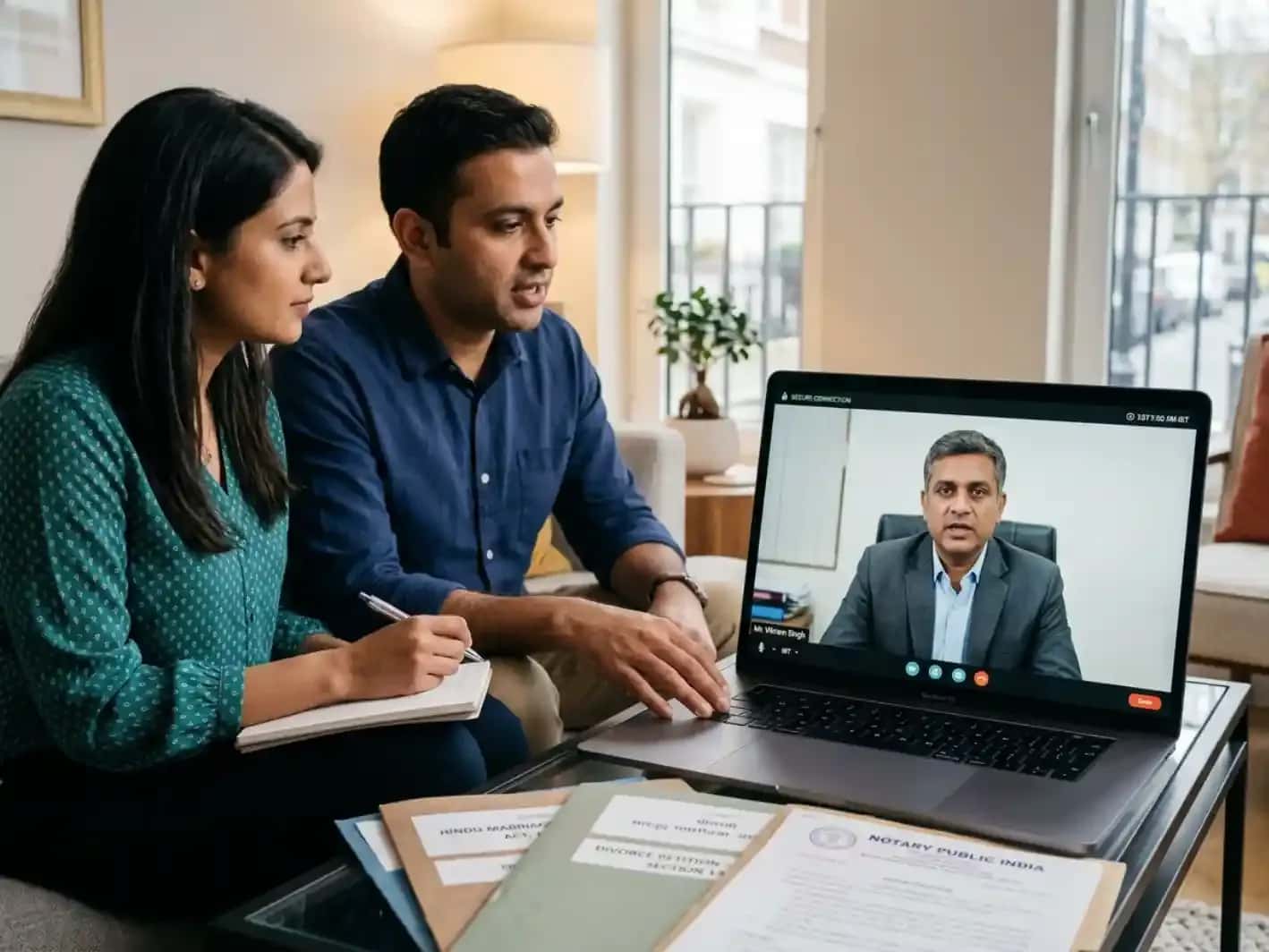
An NRI divorce lawyer in Mumbai handles the Indian divorce when you live overseas but the marriage, your spouse, the children or the flat are in Greater Mumbai. That case is heard at the Family Court, Bandra. VIVS Legal files and defends it for clients abroad through a Power of Attorney, video calls and our office in Sanpada, Navi Mumbai.
Whether you are in Dubai, London, New Jersey or Toronto, the questions on this page are the Mumbai ones: whether Bandra can hear your case, which dates need you personally, what happens to the society flat, and how a Mumbai court treats a divorce granted abroad.
Last updated 29 October 2026 · VIVS Legal, Sanpada, Navi Mumbai
- Court
- Family Court, Bandra, for all of Greater Mumbai
- Jurisdiction
- Section 19 Hindu Marriage Act: place of marriage, last shared home, respondent's home, wife's home, or petitioner's home if the respondent lives abroad
- From abroad
- Power of Attorney signed at a consulate or apostilled, stamped within three months of arriving in Maharashtra
- Your presence
- Consent statements and evidence are personal; video is at the court's discretion
- Usual timeline
- Mutual consent 7 to 9 months, shorter with a waiver of the six-month gap
- Who handles it
- Adv. Swanand Pandit, Advocate, High Court of Bombay, from Sanpada, Navi Mumbai
On this page
- When an NRI divorce belongs in Mumbai
- What you can do from abroad and what needs you in Mumbai
- Your Power of Attorney for a Bandra case
- Mutual consent divorce at Bandra when one of you is abroad
- Defending a divorce, maintenance or criminal case filed in Mumbai
- The Mumbai flat, stridhan and money held in India
- Children: custody when one parent lives abroad
- Is a foreign divorce valid if you married in Mumbai?
- How we run a Mumbai case for clients abroad
When an NRI divorce belongs in Mumbai
Your divorce can be filed at the Family Court, Bandra if Greater Mumbai is where you married, where your spouse lives now, where the two of you last lived together, or, if the wife is the one filing, where she lives now. That is Section 19 of the Hindu Marriage Act, 1955. Living abroad does not take the case away from Mumbai; it only changes how you take part in it.
Section 19 has one more door that matters to families split across countries. When the respondent lives outside India, the petitioner can file where the petitioner lives. So a wife who has come back to her parents in Chembur can file at Bandra against a husband who stayed on in Dubai.
| Your situation | Is Bandra open? |
|---|---|
| You married in Mumbai and now both live abroad | Yes, as the place of marriage |
| You work in London; your spouse lives with family in Borivali | Yes, where the respondent lives |
| The wife has returned to Mumbai; the husband is in the Gulf | Yes, under the wife's residence and the respondent-abroad rule |
| You lived together in Powai, then one of you moved abroad alone | Yes, as the last shared home |
| Your spouse's family lives in Thane or Navi Mumbai, not Greater Mumbai | No: the case goes to Thane or to CBD Belapur |
The family court at Bandra covers all of Greater Mumbai, the island city and the suburbs. Couples whose link is to Vashi, Nerul or Kharghar belong at Belapur, and our NRI divorce lawyer page for Navi Mumbai covers that court. The Special Marriage Act, 1954 has the same scheme in Section 31. Muslim, Christian and Parsi marriages follow their own statutes, set out in our note on divorce laws for NRI couples.
What you can do from abroad and what needs you in Mumbai
Most of a Bandra case can be run without you in the courtroom. Two things cannot: your own statement of consent in a mutual divorce, and your own evidence in a contested one. Even those can often be given by video, if the court allows it.
| Stage | Who does it | Your part from abroad |
|---|---|---|
| Drafting the petition or reply | We draft from your instructions | Calls and documents by email |
| Signing the petition and affidavit | You | Signed and sworn before an Indian consular officer, or before a notary and apostilled |
| Filing and routine dates | Your advocate, with the court's leave | Nothing on most dates |
| Counselling and settlement efforts | The court's counsellor | Often needed in person; video is at the court's discretion |
| Statements in a mutual consent case | You | By video, or through a close relative, where the court permits |
| Evidence in a contested case | You | In the witness box, or by video if the court agrees |
| Certified copy of the decree | Your attorney or us | Nothing |
Two judgments set these limits. Under Section 13 of the Family Courts Act, 1984, an advocate appears only with the court's permission, which is routinely sought. In Santhini v Vijaya Venketesh (2017), the Supreme Court left video hearings in matrimonial cases to the family court, to be used once settlement has failed. For mutual consent divorces, Amardeep Singh v Harveen Kaur (2017) allowed courts to use video conferencing and to accept representation by a parent or sibling where a spouse cannot attend for a good reason.
Your Power of Attorney for a Bandra case
A Power of Attorney lets a person in Mumbai act for you: sign routine applications, attend dates, receive papers and collect certified copies. It does not let that person give evidence in your place about things only you know. The Supreme Court said so in Janki Vashdeo Bhojwani v IndusInd Bank (2005), and family courts apply it strictly.
- Where to sign. At an Indian embassy or consulate, or before a local notary followed by an apostille in a country that is party to the Hague Apostille Convention.
- Stamping in Maharashtra. A document signed outside the state must be stamped within three months of first arriving here, under Section 19 of the Maharashtra Stamp Act. We arrange it as soon as the courier reaches us.
- Who to appoint. Someone who lives within reach of Bandra and will answer the phone on a hearing day. A specific Power of Attorney for this one case is safer than a general one.
- Ending it. Revoke it in writing once the decree is collected, and tell us so the court record is updated.
Our guide to the Power of Attorney for NRIs in India has the wording, the attestation routes and the common mistakes.
Mutual consent divorce at Bandra when one of you is abroad
A mutual consent divorce under Section 13B is the shortest route for an NRI couple: agree the terms in writing, file one joint petition at Bandra, give two statements of consent, and receive the decree. Both spouses must have lived separately for at least a year before filing.
- Write the consent terms. Alimony and how it is paid across borders, stridhan, the flat and any home loan, custody and access across countries, and the withdrawal of every other case, Indian or foreign.
- Sign the joint petition. The spouse abroad signs at a consulate or before a notary with an apostille; the spouse in Mumbai signs at our office or before the court.
- First motion. The petition is presented and both statements are recorded, the spouse abroad by video where the court allows it.
- Six months, or a waiver. The second motion normally follows after six months. Under Amardeep Singh, the court can waive that wait if you had already lived apart for eighteen months by the first motion, mediation has failed, and alimony and custody are settled.
- Second motion and decree. Consent is confirmed again and the decree is passed.
- Carry out the terms. Transfer the flat, close joint accounts, withdraw the agreed cases and send the certified copy to any foreign lawyer who needs it.
With a waiver, a mutual divorce at Bandra can finish within a few months of filing; without one, expect seven to nine months. The full Mumbai procedure for couples who both live here is on our divorce lawyer in Mumbai page.
Defending a divorce, maintenance or criminal case filed in Mumbai
If your spouse has filed in Mumbai, reply on time even if you think the court has no jurisdiction. A family court that hears nothing from you can decide the case without you, and maintenance orders made that way are enforced against your bank accounts and property in India.
Divorce and maintenance
We file the written statement, any objection to jurisdiction, and the affidavit of assets and liabilities that every maintenance case now requires after Rajnesh v Neha (2020). For an NRI that affidavit includes foreign salary, overseas accounts and property abroad, and courts check it against tax returns. Maintenance can also be claimed under Section 144 of the Bharatiya Nagarik Suraksha Sanhita, 2023, and under the Domestic Violence Act, 2005, which lets a wife file where she is staying, even temporarily.
A complaint of cruelty
Cruelty by a husband or his relatives is now Section 85 of the Bharatiya Nyaya Sanhita, 2023, which replaced Section 498A of the old Penal Code. If a complaint is lodged at a Mumbai police station, three things matter to someone living abroad: anticipatory bail under Section 482 of the BNSS before you travel, the arrest safeguards in Arnesh Kumar v State of Bihar (2014), and your passport. A pending criminal case is a ground on which a passport can be refused or impounded under Section 10(3)(e) of the Passports Act, 1967, and it can lead to a Look Out Circular at the airport.
We advise on the criminal side and the divorce in the same file, so a settlement in one covers the other. See also whether an NRI can file for divorce in India.
The Mumbai flat, stridhan and money held in India
A divorce decree does not move ownership of a Mumbai flat. Whatever the consent terms say, the transfer happens only through a registered deed and, in a cooperative housing society, a fresh share certificate.
- Transfer between spouses. A gift of a residential flat to a spouse carries concessional stamp duty of ₹200 under Article 34 of the Maharashtra Stamp Act. The deed is registered before the Sub-Registrar, which the spouse abroad can do through a Power of Attorney.
- A flat bought with money from abroad. Keep the remittance trail: bank statements and NRE or NRO account records. They show who paid, which matters when the flat is weighed in permanent alimony under Section 25.
- A joint home loan. The lender must agree before either borrower is released. Build its consent into the timetable before the second motion.
- Stridhan. Jewellery and gifts given to the wife remain her own property, as the Supreme Court held in Pratibha Rani v Suraj Kumar (1985). List every item and any bank locker in the consent terms.
Where the flat is part of the settlement, our property lawyers in Mumbai check its title and draft the deed in the same file, so it registers alongside the decree.
Children: custody when one parent lives abroad
A Mumbai court decides custody by one test: the welfare of the child. Under Section 9 of the Guardians and Wards Act, 1890, the case goes to the court where the child ordinarily lives, which for a child living in Greater Mumbai is the Family Court at Bandra.
Where a child has been brought to Mumbai from abroad by one parent, the other parent usually files a habeas corpus petition in the Bombay High Court. India has not signed the Hague Convention on child abduction, so return is not automatic. In Nithya Anand Raghavan v State of NCT of Delhi (2017), the Supreme Court held that a foreign court's custody order is one factor to weigh, not an instruction to obey. Courts look at schooling, the child's own wishes and how long the child has lived here.
Access across countries works best when it is written precisely: video calls on fixed days, which school holidays the child spends abroad, and who keeps the passport.
Is a foreign divorce valid if you married in Mumbai?
A divorce granted abroad is valid in India only if it passes Section 13 of the Code of Civil Procedure, as the Supreme Court read it in Y. Narasimha Rao v Y. Venkata Lakshmi (1991). In plain terms, the foreign court should have granted it on a ground known to the law you married under, and your spouse should have taken part in that case or agreed to the result.
A decree obtained on a ground Indian law does not recognise, while the spouse in Mumbai never appeared, is the weak case. Before you remarry in India, sell the Mumbai flat or claim an inheritance, have the decree tested. If there is doubt, the Bandra Family Court can declare your marital status under Section 7 of the Family Courts Act, or a fresh mutual consent divorce can be filed in Mumbai. Country-specific questions are on our pages for NRIs in the USA, the UK and Dubai.
How we run a Mumbai case for clients abroad
Your case is handled by Adv. Swanand Pandit, Advocate, High Court of Bombay, from our office at Office 219, Haware Intelligentia Park, Sector 24, Sanpada, Navi Mumbai. We are open Monday to Saturday, 9:00 AM to 6:00 PM India time, which falls in the morning in the Gulf and the UK. Clients in North America usually book an early slot.
- A first call to settle the court, the route and the papers
- Drafts sent by email, signed abroad, originals couriered to Sanpada
- Family members in Mumbai can meet us at the office by appointment
- An update after every hearing, with the next date and what it needs from you
- The fee agreed at the first consultation, with any travel to other courts priced separately
For other countries and other Indian cities, start from our NRI divorce lawyer services. To book a call, contact VIVS Legal.
Frequently Asked Questions
Still have a question?
Speak with our legal team about your matter with clarity and confidence.
Yes, if Greater Mumbai is where you married, where your spouse lives, or where you last lived together. A wife living in Mumbai can also file there. And when the respondent lives outside India, the petitioner may file where the petitioner lives, under Section 19 of the Hindu Marriage Act.
For most dates, yes, as your attorney under a Power of Attorney, alongside your advocate. In a mutual consent divorce the court may also accept a close relative where you cannot attend for a good reason. Your own evidence, though, has to come from you, in person or by video.
Often not. You sign the petition abroad at an Indian consulate or before a notary with an apostille, and the family court may record your consent by video. Some judges still want both spouses present at counselling, so we confirm the Bandra court's practice before you book any tickets.
Travel carefully. A complaint under Section 85 of the Bharatiya Nyaya Sanhita can lead to a Look Out Circular or action on your passport while it is pending. Apply for anticipatory bail in Mumbai before you fly in, and take advice before leaving India again during the case.
Only if it passes Section 13 of the Code of Civil Procedure as read in Narasimha Rao. If your spouse took part or consented and the ground matches Indian law, it usually holds. If not, ask the family court for a declaration or file a fresh mutual divorce in Mumbai.
Whoever owns it on paper, unless the settlement transfers it. The decree changes nothing by itself. A transfer needs a registered deed and, in a housing society, a new share certificate. A gift to a spouse carries ₹200 stamp duty, and the spouse abroad can sign through a Power of Attorney.
Usually seven to nine months from filing, because of the six-month gap between the two motions. If you had lived apart for eighteen months before the first motion and every term is settled, the court can waive the gap, and the case may finish within a few months.
The court can treat a refused or deliberately avoided notice as served, once it is satisfied with the proof, and then proceed without your spouse. We serve through the court, by registered post and electronically where allowed, and keep the delivery record so this question does not delay the case.
Only if your wife herself lives in Greater Mumbai now, or you last lived together there. Her parents' address alone is not enough. If you both live abroad and married abroad, Section 19 may leave no Indian court open, and we would check the foreign route first.
Same service, other locations

Need Legal Assistance?
Get a consultation from our legal team today.