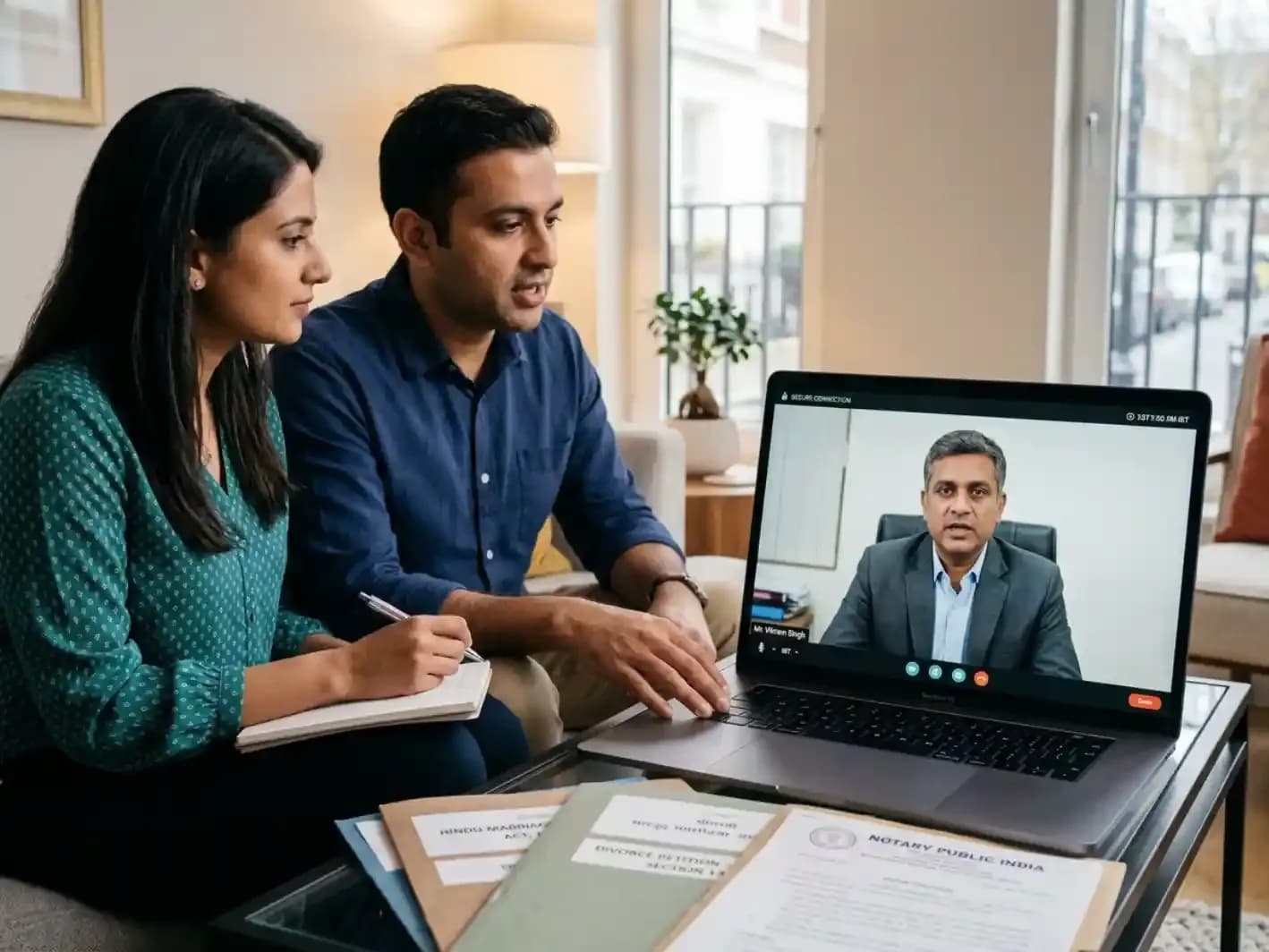
- Use a special power of attorney tied to one property and a short list of named acts; leave out the power to sell unless a sale is actually planned.
- Sign it abroad before a notary and get an apostille, or sign at the Indian embassy or consulate; ink signatures only, and the original has to travel to India.
- From the day it reaches India, the holder has three months to get it stamped, usually through adjudication by the Collector of Stamps.
- A PoA lends authority but never transfers ownership, and it ends on your death; rent and sale money should reach only your own account.
- Keep control with a fixed period, written reports, the title deeds in your own hands and a registered revocation if trust breaks down.
On this page
- What is a power of attorney for NRI property?
- Which powers should the PoA include for each task?
- Who should you appoint as your attorney in India?
- How do you sign a PoA abroad?
- What happens when the PoA reaches India?
- What are the risks of giving a PoA, and how do you keep control?
- Is a power of attorney enough for NRI property management in India?
- What to do next
What is a power of attorney for NRI property?
A power of attorney (PoA) is a document by which you, the principal, authorise another person, called the attorney or PoA holder, to do specified things in your name. For an NRI, those things are mostly about property in India: collecting rent, paying property tax, dealing with the housing society, applying for mutation, defending a case and sometimes signing a sale. The Powers of Attorney Act, 1882 and the agency chapter of the Indian Contract Act, 1872 govern it.
Three rules decide how you should use it. First, it lends your authority and never moves your ownership. Property sold "on GPA" without a registered sale deed does not pass title, as the Supreme Court made clear in Suraj Lamp and Industries v State of Haryana (2011). Second, the authority ends when you die or lose mental capacity (Section 201 of the Contract Act), so a PoA is no substitute for a will. Third, the holder may do only what the words allow, and loose words will be read widely by whoever relies on them.
General or special: which should you sign?
A general power of attorney (GPA) covers a class of affairs, such as "all my property and bank matters in India". A special power of attorney (SPA) covers one act or one defined set of acts, such as letting Flat 702 in a named building and collecting its rent. For NRI property management in India, an SPA for each property is the safer choice. Sub-Registrars and banks test every act against the wording, and a narrow document gives them less to query and the holder less room to stray.
A GPA still has its uses. An elderly owner abroad who wants one child in India to run everything may need wider powers. Even then, selling, mortgaging and gifting should sit in separate clauses, included only if you really mean them.
Which powers should the PoA include for each task?
Draft from the task backwards. Write down what the holder will actually do in the next year or two, and give only those powers. The table shows what we usually write in for common NRI tasks, and what we keep out or limit.
| Task | Powers to write in | Keep out or limit |
|---|---|---|
| Letting the flat. | Sign and register a leave and licence agreement, collect rent into your account, serve notices on the licensee. | Rent paid to the holder's own account; terms longer than you have approved. |
| Society and municipal work. | Attend meetings, pay maintenance and property tax, apply for NOCs, sign nomination and membership forms. | Voting on redevelopment or signing any development agreement without your written instruction. |
| Mutation and land records. | Apply for mutation, property card or 7/12 entries and certified copies, and swear affidavits about the holder's own acts. | Affidavits on facts only you know, such as family history or how the property was bought. |
| Selling the property. | Execute the sale agreement and the conveyance for a named buyer or a minimum price, and admit execution before the Sub-Registrar. | Receiving the price; selling to the holder or the holder's relatives. |
| A court or RERA case. | Sign the vakalatnama, verify pleadings from the records, attend hearings and apply for copies. | Settling or withdrawing the case without your written consent. |
Two clauses belong in all of them. A reporting clause, so the holder sends you a copy of everything signed and a receipt for every payment. And a clause on substitutes, which should normally say the holder cannot hand the powers on to anyone else.
Who should you appoint as your attorney in India?
Choose for reliability first and for reach second. The holder will have to visit the Sub-Registrar, the society office and perhaps a court, so someone living in the same city as the property saves months. A parent, sibling or adult child is the usual choice, and in Maharashtra a power to sell given free to close family is far cheaper to stamp than one given to an outsider.
- Do not appoint the buyer, the builder or a broker as your attorney for a sale. They sit on the other side of the deal.
- If two relatives will be involved, consider making them act jointly for a sale, so that neither can sign alone.
- Pick someone who expects to stay in India for the whole period. A holder who moves abroad leaves you with a document nobody can use.
- For a court case, pick the person who actually dealt with the property. A holder can give evidence only on what they personally know, as the Supreme Court held in Janki Vashdeo Bhojwani v IndusInd Bank, (2005) 2 SCC 217.
If the main job is a case rather than day-to-day management, the wording is quite different. Our page on power of attorney for court cases explains how a litigation PoA is drafted.
How do you sign a PoA abroad?
There are two routes, and both need your ink signature on paper. An electronic signature will not work, because the Information Technology Act, 2000 leaves powers of attorney outside its scope.
- Notary and apostille. You sign before a local notary, and the country's competent authority then apostilles the notary's signature. India and most countries where NRIs live are parties to the Hague Apostille Convention, so a power of attorney apostille needs no further legalisation for use in India.
- Indian mission. The Indian embassy, high commission or consulate attests your signature, at its own counter or through the outsourcing agency it uses. This route works in every country, including those outside the Convention.
On either route, attach recent photographs of you and the holder, give passport and address details for both, and have two witnesses sign with their own details. Check the mission's current document list before you book, because appointment systems and forms change.
PoA for property in India from the USA
In the USA the apostille comes from the Secretary of State of the state where your notary is commissioned, not from the federal government. Sign before a New Jersey notary, and the New Jersey Secretary of State apostilles it. The Indian Embassy in Washington DC and the Consulates General are the alternative. Our property page for NRIs in the USA covers buying and selling from there.
UK, Canada, Australia and the Gulf
In the UK the FCDO Legalisation Office issues the apostille, and in Australia the Department of Foreign Affairs and Trade does. Canada joined the Convention with effect from 11 January 2024. Canadian NRIs therefore no longer need provincial authentication followed by attestation at an Indian mission; the apostille comes from Global Affairs Canada or, for documents from some provinces, the provincial authority. Gulf countries differ from one another, so start with the Indian mission's current process there.
Can you sign it in India instead?
Yes, if you are visiting. A PoA signed and registered before a Sub-Registrar during your trip avoids the courier, the apostille and the three-month stamping window, and it is rarely questioned later. Book it early in the trip, because you must attend in person with identity proof and two identifying witnesses.
What happens when the PoA reaches India?
The clock starts when the original first arrives in India, not when you signed it. Section 18 of the Indian Stamp Act, 1899, and the matching rule in state stamp laws such as the Maharashtra Stamp Act, 1958, give a document signed abroad three months, counted from its first receipt in India, to be stamped. Keep the courier receipt, because it proves the arrival date.
Power of attorney adjudication is the usual way to stamp it. The holder presents the original at the district office of the Collector of Stamps, the Collector assesses the duty, the holder pays it, and the document is endorsed as duly stamped. Miss the three months and the document can be impounded and a penalty charged on top of the duty. Until that is settled, a Sub-Registrar, bank or court will not act on it.
How much stamp duty will it cost?
That depends on the state and on what the PoA allows. Under the Maharashtra Stamp Act, a PoA for management or for a single transaction carries a modest fixed duty. A power to sell is treated very differently. Given to someone outside the close family, it can attract duty at the conveyance rate on the market value of the property, while a power given free to your husband or wife, a parent, a child or a brother or sister attracts only a fixed sum. We confirm the current entry for your property and holder before you sign, so the bill at adjudication is not a surprise.
Does it have to be registered?
Stamping and registration are separate steps. Many PoAs used only for management are stamped but never registered. Registration matters when the holder will present a sale deed or a leave and licence agreement for registration on your behalf: Sections 32 and 33 of the Registration Act, 1908 then require a PoA signed abroad to carry the authentication of a notary public, a court or an Indian consular officer in that country. Some states also require a PoA that allows the sale of land to be registered, and many banks expect it.
At the registration of a sale, Sub-Registrars in Maharashtra commonly ask the holder to declare that you are alive and have not revoked the PoA. Stay reachable on that day.
What are the risks of giving a PoA, and how do you keep control?
Misuse rarely starts with fraud. It usually starts with a wide document, a holder under family pressure and an owner who stops checking. These are the patterns that come up most often:
- A management PoA with a power to sell or mortgage buried in it, used years later.
- Rent or sale money routed to the holder's account and never accounted for.
- A substitute appointed by the holder, whom you have never met.
- The PoA used after you revoked it, with a bank or Sub-Registrar who was never told.
- Keys handed to a "caretaker" who later claims a right to stay.
The controls are simple, and most of them are drafting choices:
- Describe the property by CTS or survey number, village, building and flat, and cover nothing else.
- Fix a period, such as one or two years, and renew it if the work is not finished.
- Direct every payment to your own NRO or NRE account, named in the document.
- Require copies of each signed document within a week of signing.
- Keep the original title deeds yourself, or with someone other than the holder.
- Check the registration index for the property now and then; in Maharashtra, recent registrations can be searched online.
Revoking the PoA
Revocation is done by a deed of revocation, which should be registered if the PoA itself was. Write to the holder, and send copies to everyone likely to rely on the old document: your bank, the society, any tenant and the Sub-Registrar's office. Notice matters because Section 208 of the Contract Act protects anyone who dealt with the holder in good faith before hearing of the revocation. If the holder has already caused a loss, or someone is in possession and will not leave, read our note on illegal possession of NRI property.
Is a power of attorney enough for NRI property management in India?
No. A PoA lets someone act for you, but it cannot cure a problem in the property itself. A gap in the title chain, an inheritance never put into your name, a tenant who will not leave or a builder who has not delivered each needs its own legal route; the PoA only lets your holder take those steps without you.
- Inherited property. Mutation needs the succession papers: a will, with probate where one was obtained, or a succession certificate or legal heir documents, often with release deeds from the other heirs.
- Tenants. Section 55 of the Maharashtra Rent Control Act, 1999 makes registration of every leave and licence agreement compulsory. A registered agreement is also what lets you seek possession from the Competent Authority at the end of the term, instead of filing an ordinary suit.
- Tax. A tenant paying rent to an NRI has to deduct tax at source, now under the Income-tax Act, 2025 (the duty the old Act placed in Section 195), and a buyer from an NRI deducts tax on the price. Your holder should collect the TDS certificates for your chartered accountant.
- Sale money. FEMA lets NRIs take sale proceeds abroad within limits that depend on how the property was paid for. Plan the remittance with your bank before the sale, not after.
Our NRI real estate services page sets out the work that usually runs alongside a PoA: title checks, sales, inheritance and disputes.
What to do next
If you are about to give a PoA for property in India, take it in this order:
- List the tasks. Write down what the holder must do, for which property, and for how long.
- Choose the holder. Someone in the property's city, available for the whole period, with no stake in any deal.
- Have it drafted for India. The property described from the title papers, named powers, payments to your account, reporting and revocation clauses.
- Sign it where you live. Notary and apostille, or the Indian mission; ink signatures, photographs and witnesses.
- Courier the original and stamp it. The holder has it adjudicated by the Collector of Stamps within three months of arrival.
- Register it if needed, then use it. Register where the state or the task requires it, and ask for copies of everything signed.
We draft property PoAs for NRIs from Sanpada-Vashi, Navi Mumbai, working by phone, WhatsApp and video call, with drafts and scans exchanged by email. Our charge for this is a fixed fee from Rs 7,000, set out on our power of attorney drafting page. For a property anywhere in Maharashtra, including Mumbai and Navi Mumbai, we also guide your holder through adjudication and registration and can act in any case that follows. For property in another state, we tell you at the first consultation how that part will be handled and what it costs.

Founder and Managing Partner, VIVS Legal. BLS, LL.B, LL.M, PGDBM, JAIIB.