
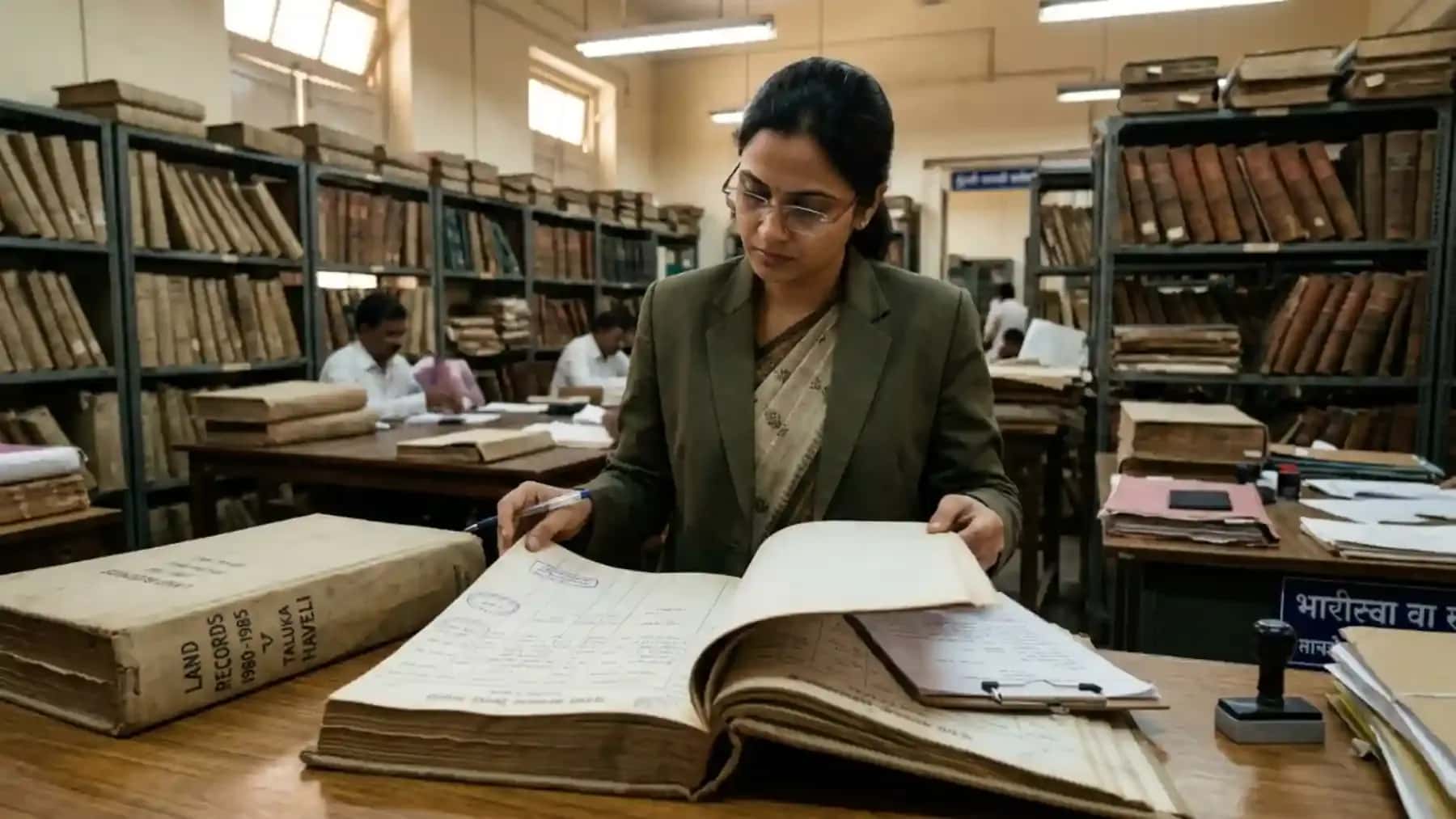
Title search in Amritsar: jamabandi, fard, intkal and the colony NOC
A title search in Amritsar tells you whether the seller truly owns the property and can sell it. We compare the registered deeds with the Punjab land record (jamabandi, fard and intkal), then check the colony's approval, bank charges and court cases. You get a written report before you pay.
Visit our Amritsar office at Chamber No. 9B/1, District Court, by appointment, or email scans and speak to us on a video call.
Last updated 6 November 2026 · VIVS Legal, Sanpada-Vashi, Navi Mumbai
Legal lead: Adv. Swanand Pandit, Advocate, High Court of Bombay
- Records searched
- Jamabandi, fard, intkal and roznamcha; registered deeds; colony and scheme files; CERSAI; court and revenue cases
- Usual search period
- 30 years, and further where a chain leads to an old allotment or shamlat entry
- Offices involved
- Tehsil and sub-registrar offices, Amritsar Development Authority, Improvement Trust, Municipal Corporation, RERA Punjab
- Law
- Punjab Land Revenue Act 1887, Registration Act 1908, Indian Stamp Act 1899, PAPRA 1995, RERA Act 2016
- Usual timeline
- Depends on the chain and how old the records are; we give a date after reading the papers
- Where to meet us
- Chamber No. 9B/1, District Court, Amritsar, by appointment, or by video call
On this page
- Visit our Amritsar office
- What does a title search in Amritsar have to prove?
- How to read a fard, jamabandi and intkal
- Which offices and records does an Amritsar search cover?
- Can a plot in an unauthorised colony in Amritsar be registered?
- Title search by type of Amritsar property
- What should NRI owners and buyers in Amritsar check?
- The search from first paper to final report
- Papers to collect from the seller
- Timing and fees for an Amritsar title report
- Warning signs in an Amritsar property file
- Title search beyond Amritsar and related help
Visit our Amritsar office
Visit our Amritsar office at Chamber No. 9B/1, District Court, Amritsar, Punjab. This is the chamber of Adv. Deepak Sabharwal, Punjab and Haryana High Court. Appointments are made first, by calling +91 8291849797 or +91 9167710454 or writing to info@vivs.in.
The firm's head office is in Sanpada-Vashi, Navi Mumbai, and Adv. Swanand Pandit (BLS, LL.B, LL.M, PGDBM, JAIIB; Advocate, High Court of Bombay) leads its property practice. If you live abroad or elsewhere in India, scans by email plus a video call also work.
What does a title search in Amritsar have to prove?
It has to show that the seller owns what they claim, can transfer it, and that the land may lawfully be sold in its present form. In Amritsar, that answer sits in three separate trails.
- The registered deeds, which show how ownership passed from one person to the next.
- The Punjab revenue record, which shows who is entered as owner, in what share, and of which khasra numbers.
- The planning status: whether the colony is licensed or regularised, and whether a no-objection certificate is needed.
Section 44 of the Punjab Land Revenue Act, 1887 presumes a jamabandi entry to be true until the contrary is proved. But the Supreme Court has said more than once that a revenue entry does not itself confer title and serves a fiscal purpose. So a clean fard is good evidence, not the end of the enquiry.
How to read a fard, jamabandi and intkal
The Punjab Land Records Society's jamabandi portal lets anyone look up an entry by owner name, khewat, khatauni or khasra number. These are the terms you will meet.
| Term | What it is | What to test |
|---|---|---|
| Jamabandi | The periodic record of rights: owners, cultivators and their shares. | Whether the seller appears, and for how much of the holding. |
| Fard | A copy of the entry for a holding. | Its date, and whether it is a plain printout or a certified copy. |
| Khewat and khatauni | The ownership holding number and the cultivation holding number. | Co-sharers, and anyone cultivating who is not the owner. |
| Khasra | The number of an individual field or parcel. | Whether the deed's numbers match the current record. |
| Intkal | A mutation. Section 34 requires a person acquiring a right to report it to the patwari. | Whether every sale and inheritance was mutated, or any mutation refused. |
| Roznamcha and rapat | The daily register, with entries for events such as court orders and loans. | Entries not yet in the jamabandi. |
| Nishandehi | Demarcation of the boundary on the ground by revenue staff (sections 100 and 101). | Whether the land possessed is the land recorded. |
Three limits matter. The portal says its digital record of rights starts in 2002, so an older chain has to be followed at the tehsil. A name in a joint khewat often means a fractional share, not a marked plot, unless a partition is on record. And where a village went through consolidation of holdings, khasra numbers in early deeds may not match today's.
Which offices and records does an Amritsar search cover?
Amritsar district has six tehsils: Amritsar-I, Amritsar-II, Ajnala, Baba Bakala, Majitha and Lopoke. The tehsil decides whose land record applies. It no longer tells you where a deed was registered, because Punjab's Easy Registry system, rolled out in 2025, lets any sub-registrar in a district register property from anywhere in that district. A search that looks at one office alone can miss a deed.
| Office or record | What the search looks for |
|---|---|
| Jamabandi portal, Easy Jamabandi and the tehsil's land record staff | Current and older jamabandis, intkal history and roznamcha entries. |
| Sub-registrar offices, through NGDRS and Easy Registry | Registered deeds, mortgages, leases and powers of attorney affecting the property. |
| Amritsar Development Authority and PUDA | Licensed and regularised colonies, change of land use and lists of unauthorised colonies. |
| Amritsar Improvement Trust | For Trust schemes: the allotment file, payments, transfers and conditions on sale. |
| Municipal Corporation Amritsar | Property tax, arrears and sanctioned building plans, inside municipal limits. |
| RERA Punjab | The project's registration, title papers and complaints. |
| CERSAI and lenders | Charges registered by banks and housing finance companies, which may not show in the revenue record. |
| Courts and revenue forums | Suits in the Amritsar district courts, writs in the Punjab and Haryana High Court, and revenue proceedings, including Collector's cases on shamlat land. |
Can a plot in an unauthorised colony in Amritsar be registered?
Generally, not without a no-objection certificate or a regularisation certificate. The rule has moved several times since 2024.
Section 20(3) of the Punjab Apartment and Property Regulation Act, 1995 (PAPRA) stops a registrar or sub-registrar from registering a sale of a plot in a colony that has no licence, unless the required NOC is produced. The changes since 2024, as reported by The Tribune:
- 2024: A new sub-section (5) let plots of up to 500 square yards be registered without an NOC, where an agreement or power of attorney existed by 31 July 2024.
- 2025: The Punjab and Haryana High Court, hearing a public interest petition, directed compliance with Section 20(3). The state then stopped registering such plots without an NOC.
- July 2026: The Cabinet amended Rule 31 of the PAPRA Rules. A promoter or resident welfare association could apply to regularise a colony where at least 25 per cent of plots were developed, with 30 September 2026 as the last date. After a provisional certificate and the fee, plot holders may seek their own certificates and register.
As of early November 2026 we have not seen an extension of that date reported, so confirm the position when you buy. Reports also differ on how the 2024 sub-section stands after the High Court's order, so read the current order before relying on it.
Registration and regularisation are also different things: a registered deed does not make a colony lawful. The Amritsar Development Authority's website carries lists of licensed colonies, regularised colonies and plots, and unauthorised colonies developed after 19 March 2018. The Authority has told buyers to ask for approval documents, and press reports describe demolitions along the Ram Tirath, Fatehgarh Churian and Ajnala roads.
Title search by type of Amritsar property
Colony plots
Beyond the NOC, the search matches the plot on the colony layout with the deed and traces the coloniser's own title back to the agricultural owners. A khasra the coloniser never fully acquired can leave a buyer in dispute with the old co-sharers.
Improvement Trust and development authority plots
Amritsar Improvement Trust schemes such as Ranjit Avenue, and estates under PUDA and ADA, start from an allotment or auction. The file should show the original allottee, full payment, each transfer and any condition. An allotment should be checked at source, not from a photocopy.
Lal lakir houses in villages
Homes inside the lal lakir, the old village abadi, have traditionally had no jamabandi entry. Under Mera Ghar Mere Naam and the Punjab Abadi Deh (Record of Rights) Act, 2021, the state surveys these areas and issues property cards. The search asks whether a card exists, whether objections were filed and, if there is no card, what proof of possession and inheritance supports the seller.
Agricultural land and shamlat
Under the Punjab Village Common Lands (Regulation) Act, 1961, shamlat deh land vests in the gram panchayat. Questions of whether land has vested go to the Collector under Section 11, and Section 13 bars civil courts from deciding them. Panchayats have used this route against sales they call collusive. So we read the old jamabandis, not only the latest one, for any shamlat description.
Land with a Partition-era history
Some land in the district has an evacuee history: left in 1947, then allotted to displaced persons, with title resting on allotment orders and a sanad. In November 2025, the High Court ordered a CBI inquiry into allegations that evacuee land in Amritsar district had been declared private through collusive litigation; ownership was left undecided at that stage. In a Nawanshahr case published by the Punjab revenue department, the Financial Commissioner cancelled a bogus allotment and refused to protect the later purchaser. Where a chain leads back to an allotment, it has to be tested.
New flats and RERA projects
Check the project on the RERA Punjab portal, then test the promoter's rights in the land, the licence and the lender's charge. If a project stalls after you buy, see our page on RERA complaints.
What should NRI owners and buyers in Amritsar check?
If your property is left with a relative or caretaker, the first check is whether the jamabandi still shows you, and whether any mutation, lease or deed has been entered since you last looked. The state's Easy Jamabandi portal also offers an annual subscription, per khewat, that alerts owners to changes in the record.
- Powers of attorney. A power lets someone act for you; it does not transfer ownership. In Suraj Lamp (2011), the Supreme Court held that a sale agreement, general power and will do not convey title. Cancel any power you no longer need.
- Powers signed abroad. Check attestation under Section 33 of the Registration Act, 1908, and stamping in India within three months of receipt, under Section 18 of the Indian Stamp Act, 1899. See our power of attorney service.
- Agricultural land. NRIs and OCI cardholders generally cannot buy agricultural land, plantations or farmhouses under India's foreign exchange rules. Inheritance is treated differently, so take advice on the specific holding.
- Tenants. Section 13-B of the East Punjab Urban Rent Restriction Act, 1949 gives a qualifying NRI landlord a summary eviction route, upheld by the Supreme Court.
- State bodies. The Punjab State Commission for NRIs, set up under a 2011 Act, and the NRI wing of Punjab Police take complaints. The Commission has said it cannot issue a mandamus against individuals but can recommend remedial steps, so a contested title usually still goes to the civil court.
See also NRI real estate services and managing property through a power of attorney.
The search from first paper to final report
- Identify the land. We fix the village, khewat and khasra numbers, or the scheme and plot number, from the deed and fard.
- Build the chain. Each transfer is matched to its deed and intkal, and gaps go to the seller as written queries.
- Search the revenue record. Current and earlier jamabandis and mutations, plus tehsil records where the portal stops.
- Search the registers. Deeds across the relevant sub-registrar offices, then CERSAI for lender charges.
- Test planning status. Licence, regularisation, NOC, land use and sanctioned plan, with the authority that applies.
- Check disputes and claims. Court and revenue cases are searched, and a notice in an English and a Punjabi newspaper can invite objections.
- Write it up. A draft sets out each open point and who must cure it. The title report follows.
Papers to collect from the seller
Ask early, and hold back your money until the file is read.
- Registered deeds for the whole chain, including gift, exchange and partition deeds
- A recent fard and the intkal copies for each past transfer
- Inheritance papers where a past owner has died
- NOC, licence or regularisation certificate for a colony plot, with the approved layout
- Allotment letter, payment proof and transfer letters for a Trust or authority plot
- Sanctioned building plan and municipal property tax receipts
- Every power of attorney used in the chain
- The lender's closure letter and returned originals, if the property carried a loan
Timing and fees for an Amritsar title report
The time needed depends on the length of the chain and on how old the records are. Ancestral land where heirs must be traced needs more work than a recent colony deed. We give you a date once we have read the papers, not before.
What affects the fee
- How many transfers, co-sharers and khasra numbers the file contains
- Older records that need tracing at the tehsil
- Curative drafting, such as a rectification deed
Published prices
Our published prices start from Rs 18,000 for an agreement to sale with title search report, a sale deed with title search report or a commercial lease agreement with title search. For land or a whole building, the quote comes after the papers are read.
Warning signs in an Amritsar property file
- A deed with no intkal, or an intkal with no deed. The reason has to be found.
- A fard showing a share, sold as a marked plot. Without a partition on record, the buyer may be stepping into a joint holding.
- "NOC is not needed now". Ask for the provision and the date.
- A chain resting on a general power of attorney. Ask for the registered deed that passed title.
- Shamlat wording in an old jamabandi. A later private entry does not settle the matter by itself.
- Someone else in possession. Check the khatauni and visit the land.
Title search beyond Amritsar and related help
For other cities, see our pages on title search in Delhi, Mumbai and Navi Mumbai, or begin at the main property title search page. Our title search guide explains the process generally. If a search reveals a dispute, see our property lawyers page.
This page is general information about title searches in Amritsar, not legal advice on a particular property.
Frequently Asked Questions
Still have a question?
Speak with our legal team about your matter with clarity and confidence.
Search the Punjab jamabandi portal by district, tehsil and village, using the owner name, khewat or khasra number. It shows the recorded owner and shares, with mutation entries. That is a first look only. A title check also needs the deeds, older records, lender charges, court cases and the colony or scheme status.
The jamabandi is the record of rights kept for the village, listing owners, cultivators and their shares. A fard is a copy of the entry for a particular holding. Buyers usually see the fard first, so it pays to check its date and to compare it with earlier jamabandis.
Not on its own. An intkal updates the revenue record after a sale or an inheritance, and courts treat it mainly as a record for revenue purposes. Ownership rests on the deed or succession behind it. An advocate reads both together and asks why they differ wherever they do.
For a plot in a licensed or regularised colony, the approval papers normally answer this. For a plot in an unauthorised colony, expect an NOC or a regularisation certificate to be required after the High Court's 2025 directions. The rules have changed often, so confirm the current position before paying any advance.
Treat it with real caution. Shamlat deh generally vests in the gram panchayat under the 1961 Act, and a private claim may have to be established before the Collector. Ask for the order that took the land out of shamlat, and read the older jamabandis before you pay anything.
Check the current jamabandi and recent mutation entries yourself, and find out which powers of attorney are still in force. Cancel any you no longer need, and consider the state portal's alert subscription. If an entry looks wrong, get advice quickly, because a later buyer can complicate the correction.
It depends on the length of the chain and how old the records are, especially where entries before 2002 must be traced at the tehsil. Inherited land with several co-sharers needs more work than a recent colony deed. We give you a date after we have read the papers.
Yes. Email scans of the papers to info@vivs.in and go through the draft report on a video call. You can also visit the District Court chamber by appointment. Originals are usually needed only when a document has to be inspected or a defect has to be corrected.
Same service, other locations

Need Legal Assistance?
Get a consultation from our legal team today.